
When Hamner Hammered a Black Photographer
Plus some current news . . .
Pregame Pepper
. . . Unbroken Glas Dept.—Tyler Glasnow isn’t going anywhere, the Dodgers say . . . according to the righthander himself. Published reports suggest Glasnow told an ESPN reporter the team told him he wasn’t a trade item as rumours suggested.
As Yardbarker puts it, “He’s posted a 3.37 ERA with a 30.9% strikeout rate in 40 starts for the team, as well as a 1.69 ERA in six postseason contests. That’s not the type of player most teams would usually trade.”
The California native who began with the Rays is signed through the end of 2028, due $30 million over the next two years with the Dodgers holding an option after 2027.
. . . García Later, Nick Dept.—The New York Post’s Jon Heyman thinks the Phillies signing former Rangers postseason hero Adolis García to a one-year, $10 million deal for 2026 means the skids greased fully for incumbent Nick Castellanos’s farewell.
“Nick Castellanos will be gone one way or another from Philly,” posted Heyman on X. “$20M to go for 2026. You’d think some team would pay some small fraction of it, but in any case, he’s been replaced. Adolis is the new RF.”
García shone for the 2023 Rangers with 39 home runs, an All-Star berth, a Gold Glove, an American League Championship Series Most Valuable Player award, and eight postseason home runs, one shy of the record Daniel Murphy set in 2015. The big blow: that year’s World Series Game One winner in the eleventh inning, launching the Rangers to their first and so far only World Series triumph.
That’s the form the Phillies hope returns even for a single season, after García’s 2024-25 made him a non-tender candidate.
. . . Next of Kim Dept.—The Braves are gambling that Gold Glove shortstop Ha-Seong Kim has enough bounceback after an injury-battered 2025 to turn a single-season 2026 deal into a longer-term extension with the club. That’s what PBO Alex Anthopoulos has implied, anyway.
“Our goal is for him to have a great year and we keep him long-term beyond this,” said Anthopoulos of the 30-year-old who helped his own cause with a September return after the Braves snatched him from the Blue Jays by way of the waiver wire. Before his back issues, Kim was thought to be in line for at least a three-year free agency deal.
Leading Off
When Granny Hammered a Black Photographer
Hamner, shortstop of the Whiz Kids-to-be, denied race was a factor. But . . .
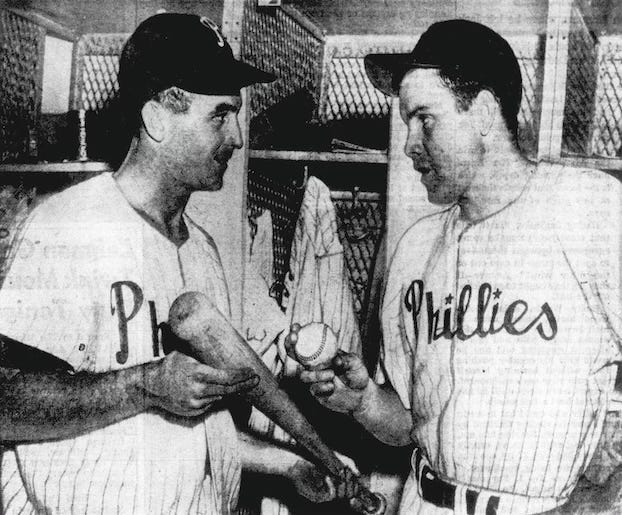
By Russ Walsh
Most baseball fans with even a passing knowledge of the history of the game know the story of Jackie Robinson, the integration of baseball, and the Philadelphia Phillies. The story was dramatized with considerable artistic license, but also considerable accuracy, in the 2013 film, 42.
In the film, Phillies manager and noted bench jockey, Ben Chapman (played by Alan Tudyk), peppers Robinson (Chadwick Boseman), the player who integrated major league baseball, with the most vicious racial taunts imaginable. The film also shows Phillies pitcher, Dutch Leonard (C. J. Nitkowski), throwing at Robinson, and Phillies General Manager Herb Pennock (Mark Harelick) discouraging Dodger management from bringing Robinson to Philadelphia to play for fear Robinson’s presence might incite violence.
By mid-1948, both Pennock and Chapman were gone. The 53-year-old Pennock had died of a cerebral hemorrhage, and Chapman was fired by Phillies owner Bob Carpenter. The racist cast of the Phillies’ dugout did not leave with Chapman, however.
For one thing, his lieutenant and fellow race-baiter Dusty Cooke stayed on, first as interim manager and then as one of new manager Eddie Sawyer’s coaches. For another thing, some of the players continued to hold views similar to Chapman. A little known late 1949 season incident illustrates this well.
On October 1, the Phillies played the Brooklyn Dodgers at Shibe Park in Philadelphia. It was a big game. The first place Dodgers needed to win to avoid a playoff with the St. Louis Cardinals. The upstart Phillies were a hard charging third place team. The Dodgers featured Robinson, of course, along with other African-American stars like Roy Campanella and Don Newcombe.
Wherever the Dodgers played in those days, it was important news for a city’s black population. Attendance at this game was a healthy 29,000, many of them Black Philadelphians wanting to see their Dodger heroes. Naturally, the Black press would take an interest, too.
Malcolm Poindexter, a young file clerk on the staff of the Philadelphia Tribune, the city’s leading Black newspaper, was assigned to take photos of the game. Poindexter had a side business as a wedding photographer, so he often picked up photography work at the Tribune.
In those days, photographers seated themselves on a bench beside the home team dugout and moved to take pictures as the occasion warranted. Poindexter was in that position when he retreated down the dugout steps for a cigarette. Rules of the day forbade smoking on the field, but it was permissible for photographers to go to the foot of the dugout steps for a smoke break.
Poindexter tells what happened next in a story that ran under his byline in the Tribune on October 4.
While smoking at the foot of the dugout steps, I heard a conversation between Granville Hamner, shortstop for the Phillies and another player. Hamner . . . queried, “I wonder why those umpires want them n------s to win? You know I believe the umpires like those n-----s.” Walking up the steps I made a note of the player’s number. As I reached the top of the steps, I turned to say a word I hoped might bring some action from the team manager. I asked Hamner, “Why don’t you send your questions through the newspaper? I’m sure they’d be only too glad to answer them.” This apparently served to anger him further whereupon he called me several unpleasant names.
Poindexter then walked off toward the photographers bench. Hamner walked swiftly up behind him and pushed him to the ground as the fans looked on in astonishment. At this point, the police showed up and escorted Poindexter out of the park. Poindexter suffered cuts and bruises on his face, his hands were skinned, and his pants torn.
The Tribune covered the incident three days later on its front page, under the headline Philles’ Player Attacks News Photog. The article highlighted the relative size of the two men. Poindexter was 5’3” and 114 pounds. Hamner 5’11” and 160.
The Tribune article also cited the comments of Frank Sullivan, the Phillies’s traveling secretary. Sullivan said that the office had heard of the incident but thought it did not go beyond words. He also said that he thought Hamner had left the city. (The Phillies season ended on October 2). None of the other newspapers in the city covered the incident.
A year later Poindexter, with the backing of Tribune editor/publisher E. Washington Rhodes, sued Hamner in federal court. According to Poindexter, as quoted by Jacob L. Goldfinger in his Medium article on the incident, “The case became embroiled in a mesh of political shenanigans and was eventually settled to both parties’ satisfaction, for the record at least.” Later reports said the Phillies paid $350 to settle the suit.
The Phillies only official reaction to the incident was to insure its players against such future lawsuits and ban photographers from the playing field. It was clear that racism on the Phillies came from the very top of the organization, owner and president Bob Carpenter.
A native of Richmond, Virginia, Hamner didn’t go on record about the incident until a profile of him by Hugh Brown was published in Sport magazine in 1952. Hamner told Brown his actions had nothing to do with Poindexter’s color, but that he had been on edge since committing some errors that contributed to the Phillies losing both ends of a doubleheader at Ebbets Field.
The Sport article didn’t question Hamner further, but it is hard to know what he was talking about, since the only 1949 doubleheader the Philles played at Ebbets Field was on July 4, several months before this incident. Hamner made no errors in that doubleheader.*
Hamner played sixteen years for the Phillies and was a cornerstone for the 1950 Whiz Kids pennant-winning team. By the time he left the Phillies in May 1959, the team had taken its first few grudging steps toward integration. Even then, progress was very slow. The only African-American player on the 1959 Phillies was utility infielder Solly Drake, who joined the team after Hamner had been traded to the Cleveland Indians. The Phillies’s first African-American to see regular playing time was outfielder Wes Covington, who joined the team in a trade from the Braves in July 1961.
As for Malcolm Poindexter, he became one of the most respected broadcast journalists in Philadelphia history. After his time at the Tribune, he was a fixture first on KYW Newsradio and later KYW-TV. At KYW, he worked as a general assignment reporter, education reporter, and program host for more than 30 years. He won four Emmys for his work and was elected to the Philadelphia Broadcasters Hall of Fame in 1996.
* Hamner started one double play and helped turn a second in the first game of the twin bill and had an RBI hit in the nightcap.—Ed.
References
DiBiase, Mathew. “Sports in Courts: Malcolm Poindexter, Jr. v. Granville Hamner,” The Text Message, August 2, 2022. Retrieved on December 10, 2025 from Sports in Courts: Malcolm Poindexter Jr. v. Granville Hamner – The Text Message
Goldfinger, Jacob L. “Poindexter vs. Hamner and the Integration of the Philadelphia Phillies,” Medium, February 23, 2024. Retrieved on December 10, 2025 from Poindexter v. Hamner and the Integration of the Philadelphia Phillies | by Jacob L Goldfinger | Medium
“Phillies Player Attacks News Photog,” Philadelphia Tribune, October 4, 1949.
Poindexter, Malcolm, Jr., “Staffman, 114 Pds, Tells of Assault by 160 Pd. Player,” Philadelphia Tribune, October 4, 1949.
Russ Walsh is a retired teacher, writer, baseball coach, and long-suffering Phillies fan, who writes for the Society for American Baseball Research and has recently begun posting his own newsletter about baseball history called The Faith of a Phillies Fan on Substack. You can reach him at ruswalsh@comcast.net.
Extra Innings: They Said It, We Didn’t . . .
Gran Hamner— he despised “Granny”—played 16 years for the Phillies, part of the time as team captain. But many years in Philadelphia were less than idyllic. When [owner Bob] Carpenter “accidentally” assigned a private detective to shadow Hamner, the relationship slipped from volatile to soap-opera-like. Nor did Hamner’s makeup ameliorate the situation. Described as “mean, hot-tempered and plenty rough,”the infielder’s “fire-eating” personality often served to pour gasoline on the proverbial fire.
—David E. Skelton, Society for American Baseball Research. Republished in The Whiz Kids Take the Pennant. (SABR, 2018.)
Hamner, who had a good arm, pitched a few innings for the Phillies in 1956-57, as his career was winding down. In 1962 he was managing in the Kansas City A’s system, and he was sort of pitching. He started to pitch a little, mostly throwing a knuckleball, just to soak up some innings and take the pressure off his young pitchers.
Well, a funny thing happened: he started to get people out. Lots of people. He started a game, threw a shutout. He started another game. In the end he pitched in 22 games, started 14 games, completed all of those, finished 10-4, and led the Eastern League in ERA.
Charlie [sic] Finley was running the A’s at the time, and they were desperate for pitchers. So, sure enough, Finley starts pressuring the A’s to being Hamner to the major leagues, and give him a second career as a knuckleball pitcher.
Hamner’s attitude was, “I had my career, thank you. I had a good career; I’d like to go back and manage now, if you don’t mind.” The A’s insisted, brought him back to the majors, and he pitched a little bit, very badly, and then retired in embarrassment, over the objections of the A’s management, who thought the 36-year-old Hamner was one of their best pitching prospects. Which, come to think of it, he probably was.
—Bill James, The New Bill James Historical Abstract. (New York: The Free Press, 2001.)
All piss and venegar, “Ham” played 150+ games in six straight seasons, made three straight All-Star teams, and fielded adroitly at both shortstop and second base . . . Branch Rickey thought him too brash, so he signed with the Phils and played 21 games with big club at 17.
—Rob Neyer, Rob Neyer’s Big Book of Baseball Lineups. (New York: Fireside Books, 2003.)
Know Your Editors
Here’s the Pitch is published daily except Sundays and holidays. Benjamin Chase [biggentleben@hotmail.com] handles the Monday issue with Dan Freedman [dfreedman@lionsgate.com] editing Tuesday and Jeff Kallman [easyace1955@outlook.com] at the helm Wednesday and Thursday. Original editor Dan Schlossberg [ballauthor@gmail.com], does the weekend editions on Friday and Saturday. Former editor Elizabeth Muratore [nymfan97@gmail.com] is now co-director [with Benjamin Chase and Jonathan Becker] of the Internet Baseball Writers Association of America, which publishes this newsletter and the annual ACTA book of the same name. Readers are encouraged to contribute comments, articles, and letters to the editor. HtP reserves the right to edit for brevity, clarity, and good taste.