
Charlie Dressen Finished Ahead Of His Team
PLUS: CC SABATHIA SAVED THIS SPORTSWRITER'S LIFE

Pregame Pepper
By creating the first SuperStation for his Atlanta Braves, the late Ted Turner laid the groundwork for all future baseball broadcasting and merits a niche in the Hall of Fame gallery . . .
Contact-hitting San Francisco second baseman Luis (Line-Drive) Arraez struck out just six times over his first 144 plate appearances this season . . .
That four-homer game by the Braves in Seattle Monday night wasn’t enough as the M’s won, 5-4, after trailing 4-0 . . .
Speaking of homers, the Yankees — already a juggernaut — added even more power by promoting slugging outfielder Spencer Jones from Triple-A . . .
Demand for Red Sox home game tickets after the axing of Alex Cora jumped 371 per cent, according to new data from Gametime — suggesting a mid-season managerial firing drives curiosity and fan interest . . .
Serious injuries have placed Houston’s season — and manager Joe Espada — in jeopardy, with position players Carlos Correa, Yainer Diaz, Jeremy Pena, and Jake Meyers all on the IL along with starting pitchers Hunter Brown, Cristian Javier, and Tatsura Imai and closer Josh Hader . . .
Pitching injuries have also hit hard north of the border, with Toronto missing Max Scherzer, Jose Berrios, Shane Bieber and Bowden Francis, all on the IL along with newcomer rotation arm Cody Ponce, out for the remainder of the season . . .
In Los Angeles, two-way Dodgers star Shohei Ohtani, obviously healthy this season, has yielded only two home runs — both in the same game (a 2-1 loss to Houston).
Leading Off
Charlie Dressen and the Senators
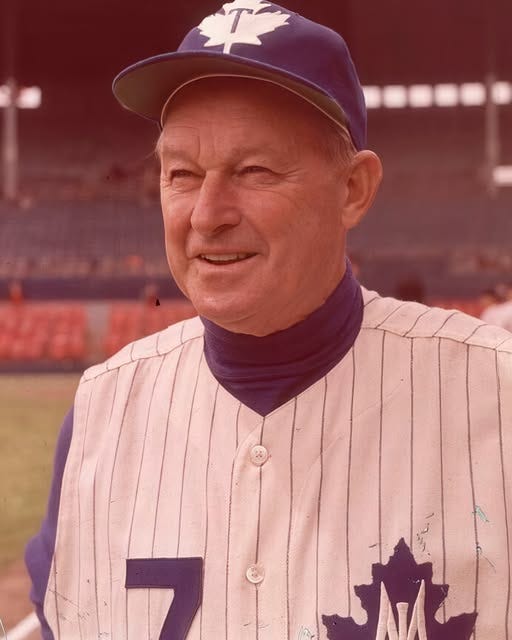
By Andrew Sharp
In October 1954, Charlie Dressen was the last man hired to manage the Washington Senators while Clark Griffith was alive. However, the “Old Fox,” in his 80s, delegated the duty to his nephew and informally-adopted son Calvin Griffith.
Every previous manager hired while the senior Griffith owned the team had played for the Senators. Yet Calvin’s choice of Dressen seemed sensible enough. Dressen had been let go after leading the Brooklyn Dodgers to two (and nearly three) National League pennants when he demanded a multi-year contract.
Dodgers owner Walter O’Malley rejected his manager’s demand and replaced him with Walter Alston. Still, O’Malley predicted Dressen “will steal at least six games for Washington in 1955.”
Clark Griffith had decided to let Bucky Harris go after Washington fell a notch to sixth place in 1954. The “Boy Wonder” playing manager of the 1924 World Series winner was in his third tenure with the Senators.
Harris had done reasonably well, given the talent he had to work with and Washington’s bare-bones farm system: a 17-game improvement in 1950 over 1949’s 104 losses, two games over .500 in 1952, .500 even in ’53 before falling to 22 games under in ’54, but still in sixth place. Cleveland won 111 games that season, New York won 103 and Chicago won 94. The Nats were just three games behind the fourth-place Red Sox.
Dressen scoffed at the ’54 finish. “I guarantee we won’t finish in sixth again,” he promised. Sadly, he was correct. His first Senators team lost 101 times and finished last. It may not have been a coincidence that Clark Griffith died that fall.
Yet Dressen and the senior Griffith in many ways were alike: both were small in stature (about 5-foot-6) and former players. Both were traditionalists, set in their ways, who loved to talk baseball to all who would listen.
Dressen, hired to manage five different MLB teams, obviously knew the game -- and made clear to everybody that he did. He had a big ego. A famous quote, perhaps aprocryphal, when his team was losing: “Just keep it close for an inning or two. I’ll think of something.”
An article by sports writer Curley Grieve in the May 1960 Baseball Digest was headlined “Dressen’s Feudal System.” In it, Grieve wrote that a player once left a book on the Dodgers’ bench entitled “What I know about Baseball – By Charlie Dressen.” The only word on every page was “I.”
In Brooklyn, Dressen inherited a team with five future Hall of Famers: Jackie Robinson, Duke Snider, Roy Campanella, Pee Wee Reese and Gil Hodges, not to mention 20-game winner and future MVP Don Newcombe.
The only future Hall of Famer on the ’55 Senators was a seldom used “bonus baby” whom the Nats were forced by the rules of the day to keep in the majors: Harmon Killebrew. He was five seasons away from playing regularly -– and winning his first homer crown.
An early advocate of waiting for the long ball, Dressen rarely had his batters try to steal. Until they were shortened in 1957, however, the distance to the fences made cavernous Griffith Stadium perpetually the most difficult place to hit home runs. Roy Sievers led the team with 25, but 18 were hit on the road, as were 11 of runner-up Mickey Vernon’s 14.
When they did run, the Nats were woefully unsuccessful. Between them, Pete Runnels, Eddie Yost, Vernon and Sievers stole just nine bases but were thrown out 20 times. The success rate for their eight starting players was just 34 per cent.
The data-oriented era in baseball, which eventually grew into sabermetrics, began in the late 1940s, when Branch Rickey, general manager of the Dodgers, hired Allan Roth as the team’s statistician. Roth continually updated the detailed information he had on how every Dodger pitcher did against every opposing batter. When they managed the Dodgers, Burt Shotton and Leo Durocher relished those stats. Dressen didn’t want them.
“He made little or no use of the information I provided,” Roth told author Lee Heiman, in quotes that appear in Joshua Prager’s The Echoing Green about the 1951 Giants-Dodgers playoff. “The man didn’t want help from anybody. He thought he could do it all by himself…. So Charlie just ignored me.”
Dressen’s pythagorean win total, based mostly on run scored vs. allowed, should have been 58 in 1955. If luck is the residue of design, as Rickey claimed, Dressen’s design didn’t produce that well.
Charlie’s design worked a bit better in 1956. Washington won 59 games. Thanks to the Kansas City Athletics losing 102, the Nats finished seventh.
The team finally and officially became the Senators for the ’57 season, but its fortunes on the field got worse. After losing 16 of the first 20 games, Dressen was fired as manager but kept on as “assistant to the president,” Calvin Griffith.
“Only reason I stayed on for awhile was because I was sure Washington would move to Los Angeles,” Dressen told Francis Stann of the Evening Star. Wrong again. The Dodgers, of course, beat Griffith to it.
Dressen returned to the Dodgers as a coach, then went on to manage the aging Braves in Milwaukee and then the Tigers.
He suffered two heart attacks while managing Detroit in 1964, ’65 and’66. He suffered the second on May 16, 1966, and had to step aside from managing. Three months later, a third heart attack claimed his life at age 71 on August 10, 1966.
When had the appropriate players, he won,” Stann wrote of Dressen in 1966. “When he didn’t … he lost.”
Andrew Sharp is a retired journalist and a SABR member who lives in central New Jersey. He was raised the D.C. area as a fan of Senators I and II. He blogs about D.C. baseball at washingtonbaseballhistory.com
Cleaning Up
How CC Sabathia Saved My Life
By Dan Schlossberg
The following article was published by Forbes.com on Feb. 12, 2019:
CC Sabathia saved my life.
If he hadn’t told New York Post sportswriters the symptoms that led to his December heart procedure, I probably wouldn’t be writing this article.
While I was covering the Baseball Winter Meetings in Las Vegas on December 11, the veteran Yankees left-hander was having a heart stent inserted at New York Presbyterian Hospital.
The procedure followed the pitcher’s complaint to Yankees medical personnel that he was suffering from acid reflux, heartburn and indigestion—exactly the symptoms I experienced during the four-day winter meetings.
Personally speaking, I am glad the 6’6” southpaw heeded the warning signs.
I knew it wasn’t natural to get winded walking the dog, making the bed or climbing a staircase I often took two stairs at a time.
The Yankees had the same reaction about their veteran starter.
General manager Brian Cashman said in a statement: “We are thankful CC was smart enough to convey his symptoms to our medical staff. We are also encouraged that the procedure CC underwent was performed as planned. He is such a dynamic person beyond his excellence on the field, and we will proceed with his health at the forefront of our priorities.
“We will continue to follow the guidance and expertise of the doctors, who have conveyed that CC will report as scheduled to Tampa in February to prepare for the 2019 season.”
Sabathia is scheduled to report to Yankees camp Wednesday, the day before Valentine’s Day, but will keep close tabs on his heart. He is on medication and is in regular consultation with his cardiologist.
The pitcher will earn $8 million in 2019, which he says will be the last of his 18 seasons in the majors. Unless Bartolo Colon rises from the baseball scrapheap again, Sabathia will start the season with more wins (246) than any other active pitcher.
Last year, he went 9-7 with a 3.65 earned run average in 29 starts. He had knee surgery in November and a stress test on January 8. His post-surgical routine also included some weight-lifting.
The heaviest man in the majors, Sabathia was listed at 300 pounds last year, but that might have been generous. Understandably, he’s more conscious of his diet and build in the wake of his heart scare. The Yankees are counting on him to be their fifth starter, behind Luis Severino, Masahiro Tanaka, trade acquisition James Paxton, and holdover free agent J.A. Happ.
Coupled with a powerful bullpen, that quintet could help the Yankees grind out another 100-win season and pose a serious American League East title threat to the defending champion Boston Red Sox.
Sabathia, who once lost a cousin prematurely because of heart disease, will have to keep tabs on his heart long after he retires.
![CC Sabathia has 246 wins, most of any active pitcher but one behind Bartolo Colon on the career... [+] list. (AP Photo/Frank Franklin II)](https://substackcdn.com/image/fetch/$s_!JA2y!,f_auto,q_auto:good,fl_progressive:steep/https%3A%2F%2Fsubstack-post-media.s3.amazonaws.com%2Fpublic%2Fimages%2F36928886-e87e-47fb-9180-19c933d4f08a_959x639.jpeg "CC Sabathia has 246 wins, most of any active pitcher but one behind Bartolo Colon on the career... [+] list. (AP Photo/Frank Franklin II)")
CC Sabathia has 246 wins, most of any active pitcher but one behind Bartolo Colon on the career list. (AP Photo/Frank Franklin II)
So will I.
I’m 70, nearly twice Sabathia’s age, and the survivor of much more invasive heart repairs. What I first thought was a mix of acid reflux, heartburn and indigestion turned into quintuple-bypass open-heart surgery—a seven-hour operation that resulted in an eight-day stay at Hackensack Meridian Medical Center in Northern New Jersey.
My surgeon and my cardiologist said that my heart was good but that the arteries were not: Two were 100% clogged, one 90% and one 60%. What began as a quadruple bypass soon turned into a quintuple. Might as well get it all, said my cardiologist, Seth Jawetz, and my surgeon, Ellie Ellmann.
How I walked five miles a day at the winter meetings will forever remain a mystery to me. I knew something wasn’t right—and even skipped a meal—but didn’t call my doctor until I lay flat on my back, with zero energy and less appetite, during Christmas week.
That’s why reading about Sabathia’s symptoms helped. When I went to see my primary physician, Harold Jawetz (father of the cardiologist), I told him I felt like Sabathia. Fortunately, he’s a longtime Yankees fan and season-ticket holder who was aware of the pitcher’s distress.
All kinds of tests followed: chest X-ray, EKG, echocardiogram, nuclear stress test and finally a catheterization that revealed the extent of the blockages.
As a baseball historian, I knew that heart issues have ravaged the game throughout its history.
In addition to Sabathia, star closer Kenley Jansen of the Los Angeles Dodgers skipped a September road trip to the Mile High City of Denver with his third bout of atrial fibrillation, marked by an irregular, racing heartbeat. The issue was quieted temporarily by a combination of rest, blood thinners and heart medication, but postseason ablation surgery—the pitcher’s second—was needed to fix the problematic electrical issue. In between, Jansen managed to pitch in the 2018 World Series.
Surviving the pressure of pitching in the last innings is tough enough in normal conditions.
John Hiller, a star left-handed relief pitcher for the Detroit Tigers, suffered a massive heart attack on January 11, 1971, at age 27. Hiller, a heavy smoker from the age of 13, missed all of that season and half of the next before staging one of the most miraculous medical comebacks in the history of the game. He wound up with a 2.83 career ERA over 15 seasons, all with Detroit, and donated much of his free time to heart-health causes.
![John Hiller during the Tigers' 50th-anniversary celebration of their 1968 World Series championship.... [+] (AP Photo/Duane Burleson)](https://substackcdn.com/image/fetch/$s_!_4W-!,f_auto,q_auto:good,fl_progressive:steep/https%3A%2F%2Fsubstack-post-media.s3.amazonaws.com%2Fpublic%2Fimages%2F7d908a46-b5f9-4d73-b073-b5eaa4cc007c_959x1532.jpeg "John Hiller during the Tigers' 50th-anniversary celebration of their 1968 World Series championship.... [+] (AP Photo/Duane Burleson)")
John Hiller during the Tigers’ 50th-anniversary celebration of their 1968 World Series championship. (AP Photo/Duane Burleson)
Some weren’t so lucky. Heart attacks killed pitchers Francisco Barrios in 1982, Darryl Kile in 2002, Jose Lima in 2010 and Ruben Quevedo in 2016. Umpire John McSherry, 51, died on Opening Day in 1996 in Cincinnati, and fellow arbiter Wally Bell passed away at age 48, one week after covering the 2013 National League playoffs. He was a survivor of a quintuple bypass 14 years earlier.
Even Hall of Famer Rod Carew wasn’t immune from heart disease; he received a donated heart and kidney in April 2017.
On the whole, though, baseball players have a life expectancy that is five years longer than the average American. Their youth and their devotion to better fitness and better lifestyles are the primary reasons. In fact, the longer the career lasts, the longer the player usually lives.
According to the American Heart Association, some 92.1 million Americans have some form of cardiovascular disease or the after-effects of stroke. The direct and indirect costs of both are more than $329.7 million per year in health expenditures and lost productivity.
Cardiovascular disease claims more lives each year than all forms of cancer and chronic lower respiratory disease combined. The nefarious disease takes a life every 38 seconds—or 2,300 per day, or 836,446 per year. Heart disease, including coronary heart disease, hypertension and stroke, remains the leading cause of death in the United States.
But all isn’t lost: Knowing the symptoms—and following Sabathia’s example and reporting them—can save lives. I’m living proof.
The American Heart Association lists seven things to avoid that should help both ballplayers and baseball writers, as well as other readers of this article. According to the AHA, “Life’s Simple 7” are smoking, physical inactivity, obesity, high cholesterol, diabetes, high blood pressure and poor nutrition.
Both CC Sabathia and Dan Schlossberg are paying strict attention.
HtP weekend editor Dan Schlossberg of Fair Lawn, NJ spent eight years as national baseball writer for forbes.com. He now covers the game for Lucas Communications, USA TODAY Sports Weekly, Sports Collectors Digest, Memories & Dreams, Here’s the Pitch, and numerous other outlets. The author of 43 baseball books, he can be booked for an appearance by emailing ballauthor@gmail.com.
Extra Innings: MLB’s Foreign Flavor
Opening Day rosters included 247 international players or 26.1 per cent of all big-leaguers in 2026 . . .
The Dominican Republic led the way with 93 players, followed by Venezuela (60), Cuba (20), and Canada (17) . . .
With 14 Japanese nationals in the majors, that country has its highest representation since 2010, when it matched that number, and second-most since 2008, when there were 16 Japanese-born players . . .
Other countries and territories with current men in the majors are Puerto Rico (14), Mexico (7), Curacao and Panama (4 each), Colombia and South Korea (3 each), and Aruba, Honduras, Nicaragua, Taiwan, and the Bahamas (1 apiece) . . .
Teams with the most foreigners are the Atlanta Braves and San Diego Padres, each with 15 . . .
Atlanta’s roster had players from the most different countries and territories — a grand total of eight, one more than both San Diego and Houston . . .
Of the 780 players carried on Opening Day rosters on March 26, 145 players appeared in at least one game of the 2026 World Baseball Classic . . .
With so many foreigners in the majors, it’s no surprise that games are carried by 162 media outlets and broadcast in 16 different languages . . .
The figures, released by Major League Baseball, were derived from a pool of 948 players, including 780 on the 26-man rosters of the 30 teams and 168 on injured or restricted lists.
Know Your Editors
Here’s the Pitch is published daily except Sundays and holidays. Benjamin Chase [gopherben@gmail.com] handles the Monday issue with Dan Freedman [dfreedman@lionsgate.com] editing Tuesday and Jeff Kallman [easyace1955@outlook.com] at the helm Wednesday and Thursday. Original editor Dan Schlossberg [ballauthor@gmail.com], does the weekend editions on Friday and Saturday. Former editor Elizabeth Muratore [nymfan97@gmail.com] is now co-director [with Benjamin Chase and Jonathan Becker] of the Internet Baseball Writers Association of America, which publishes this newsletter and the annual ACTA book of the same name. Readers are encouraged to contribute comments, articles, and letters to the editor. HtP reserves the right to edit for brevity, clarity, and good taste.
Hadn't read that story before Dan. Thanks for sharing an important one.