
Sacramento Stakes Its Claim For Permanent Club
ALSO: REMEMBERING THE LATE BOB HORNER

Pregame Pepper
Making a great case to start the All-Star Game in Philadelphia July 14, Phillies southpaw Christopher Sánchez has thrown 41 2/3 straight scoreless innings — breaking Grover Cleveland Alexander’s 1911 club record and topping Clayton Kershaw’s 2014 record of 41 . . .
He’s now chasing Orel Hershiser’s MLB mark of 59 in a row, set in 1988, which erased Don Drysdale’s 58 from 1968 . . .
The American League record remains with Walter Johnson, who tossed 55 in a row in 1913 . . .
Houston infielder Nick Allen did not hit a home run in 416 plate appearances last season for Atlanta but this season hit a home run before San Diego’s Fernando Tatís, Jr. . . .
Considering the injury wave — no, make that tsunami — that has swamped the denizens of Flushing this spring, it seems more than coincidental that the Mets wear a uniform patch promoting New York Presbyterian Hospital . . .
One of the walking wounded is lefty reliever A.J. Minter, who hasn’t thrown a pitch for the New Yorkers since April 2025 because of a torn lat that required surgery and more recent hip discomfort during his rehab . . .
Shohei Ohtani routinely leaves pitchers quaking in their boots but did the same himself at age 16 when the Great East Japan Earthquake (magnitude 9.0) struck on March 11, 2011 . . .
Because of a shoulder that needed surgical repair, Milwaukee starter Brandon Woodruff made 11 starts in 2023, none in 2024, and a dozen last year before a lat strain shut him down again . . .
If Matt Olson plays every game for the Braves for the fifth straight season, he’ll finish the year with 944 consecutive games — and the potential to pass Miguel Tejada’s 1,152 consecutive games for the No. 5 spot on the lifetime longevity list . . .
Steve Garvey holds the National League record for consecutive games played at 1,207 but American Leaguer Cal Ripken, Jr. chimed in with 2,632 in a row — a string that stopped in 1999.
Leading Off
Sacramento Takes Giant Step Toward Permanent MLB Franchise
By Dan Schlossberg
Once the owners and players of Major League Baseball resolve the issues precluding creation and implementation of labor peace, America’s National Pastime will almost certainly turn its attention to expansion.
Commissioner Rob Manfred said it’s the main thing he wants to achieve before retiring in 2029.
Two 15-team leagues don’t work for multiple reasons but a format of 32 teams does — preferably with four eight-team leagues divided into four-team divisions.
Not willing to wait in the baseball green room, Sacramento took a giant step toward securing a franchise yesterday by unveiling a campaign committee called The Sacramento Pitch.
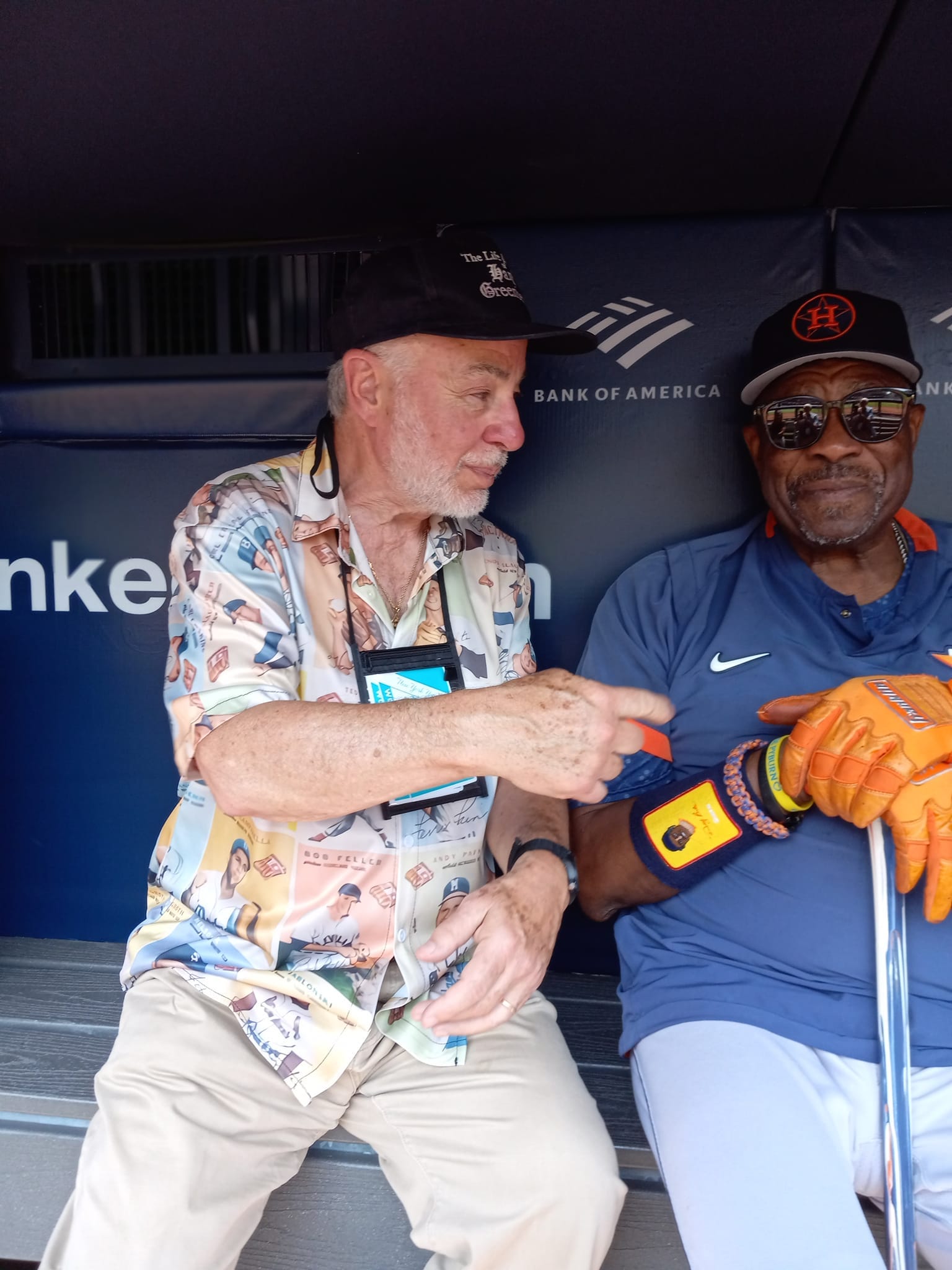
Sacramento natives Dusty Baker, a future Hall of Fame manager, and Derrek Lee, a former first baseman, are part of a steering committee that also includes mayors Kevin McCarty of Sacramento and Martha Guerrero of West Sacramento.
Led by Mark Friedman, founder and chair of the Fulcrum Property Group, the task force also includes former Pittsburgh Pirates owner Kevin McClatchy.
“There’s something different about the people here,” Baker said of his hometown. “I’ve always believed Sacramento is a major-league city. For more than a century, this region has built a proud baseball legacy and developed generations of major-league players. I could not be more excited for the prospect of bringing a permanent team here.”
West Sacramento already has a team, albeit in a limited capacity. The former Oakland Athletics are playing home games in Sutter Health Park, a minor-league facility, while their new ballpark is under construction in Las Vegas. It is slated to open in 2028.
The case for a Sacramento franchise is solid: the home of the NBA’s Sacramento Kings, it has 2.7 million residents in the immediate vicinity and 4.1 million within 50 miles. Greater Sacramento is the 20th-largest TV market in the country — making it larger than 10 current MLB cities — and is the second fastest-growing employment market in the Western United States.
That makes it the largest media market in the country with only one major sports team, according to Barry Broome, president and CEO of the Greater Sacramento Economic Council.
The city’s enthusiasm for baseball is reflected by the Triple-A Sacramento River Cats, a Pacific Coast League club that has led the minor leagues in attendance 10 times since it first started play in 2000.
A ballpark to house a potential major-league franchise for Sacramento would be built on a 50-acre downtown site controlled by the initiative’s leadership. The project would cost an estimated $2 billion produced by joint public and private financing.
Over 40 years, it would generate $1.77 billion in new tax revenue, with $1 billion to be reinvested into the ballpark district and $770 million ticketed for schools and assorted county projects.
“We’re ready,” said Guerrero. “Major League Baseball is already seeing first-hand the passion, energy, and civic pride that exists here.
“This region offers a practical and achievable path for long-term MLB success and we have the financial capacity, community support, and clear vision needed to bring Major League Baseball permanently to West Sacramento.”
The one thing they don’t have is permission from the San Francisco Giants and perhaps The Athletics, whose territorial rights could reach into the Sacramento region all the way from Las Vegas. Those issues will have to be negotiated.
HtP weekend editor Dan Schlossberg of Fair Lawn, NJ covers baseball for Lucas Communications, USA TODAY Sports Weekly, Sports Collectors Digest, and many other outlets. His email is ballauthor@gmail.com.
Cleaning Up
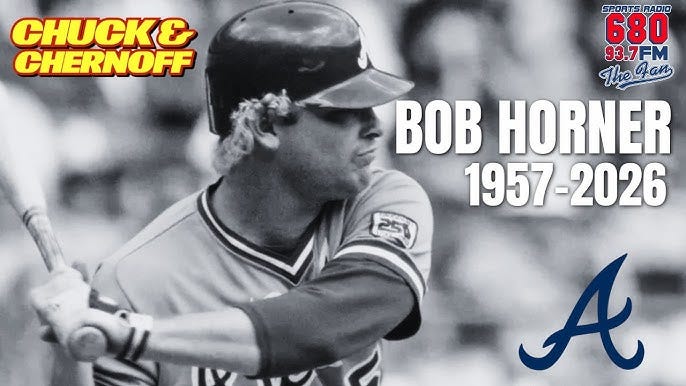
Bob Horner Skipped Minors, Had 4-Homer Game
By Dan Schlossberg
This may have been a good month for the Braves but not for their alumni.
Ted Turner died. Bobby Cox died. Former publicist Lee Walburn passed away the same week.
Now Bob Horner has joined them.
Horner, who battled not only opposing pitchers but his own weight, was only 68. The team did not announce cause of death.
Bob Horner will never reach the Hall of Fame gallery. But his accomplishments will never be forgotten.
Signed out of Arizona State, he went directly to the major leagues without passing GO or collecting $200.
With the Braves struggling, Horner joined Dave Winfield and a handful of other stars who jumped from college to the majors without so much as a cup of coffee in the minor leagues.
That was hardly a handicap to the powerful right-handed hitter, who smacked 23 home runs in 89 games. His first long ball came in his first game. That was enough to win National League Rookie of the Year honors in 1978.
Horner teamed with Dale Murphy, another young slugger, to form a 1-2 punch in the middle of a lineup that otherwise had few heroes until Joe Torre’s 1982 team finished first in the NL West (yes, the powers that be thought Atlanta was in the western United States and did not correct that error for the first 25 years of the expansion era).
Horner made history in 1986 when he hit four home runs in a game his team lost. It happened on July 6 against the Montreal Expos. The final score was 11-8.
That was the first time in the modern era (since 1901) that any team lost a game in which one of its players hit four home runs [Eugenio Suarez did it since, ironically against Atlanta].
Turner loved it — but didn’t love it when Horner and agent Bucky Woy demanded big bucks long before other players were cashing in.
Woy actually sued the owner for $17 million, claiming defamation of character cost him several clients. The outspoken Turner had bristled over bitter contract negotiations involving Horner but the case was dropped.
During a career that lasted only 10 seasons, the third baseman hit .277 and produced three 30-homer campaigns. He never knocked in 100 runs, however, because few teammates reached base ahead of him.
Had Horner burst onto the big-league scene later, he would have made millions more. His peak salary was $1.8 million — a mere pittance by modern standards. It seems Juan Soto makes that much for every home run.
Easily recognizable with his blond curly locks, Horner leaves fond memories for Atlanta fans, who supported their team even when Murphy, Horner, and future Hall of Famer Phil Niekro were its only respectable players. Many sneered and stayed away from Fulton County Stadium, claiming the occupant should change its nickname to the Bad-News Braves.
Thanks to Turner’s SuperStation TBS, millions watched on television as the Braves clawed their way back to respectability. Horner left after the 1986 campaign, playing one final season in St. Louis before leaving the game.
May he rest in peace.
HtP weekend editor Dan Schlossberg of Fair Lawn, NJ covers baseball for multiple outlets, including Lucas Communications, Memories & Dreams, USA TODAY Sports Weekly, Sports Collectors Digest, and Here’s the Pitch. His email is ballauthor@gmail.com.
Timeless Trivia: Bobbleheads Are Big Business
Bobbleheads, once a novelty, have evolved into a very big deal.
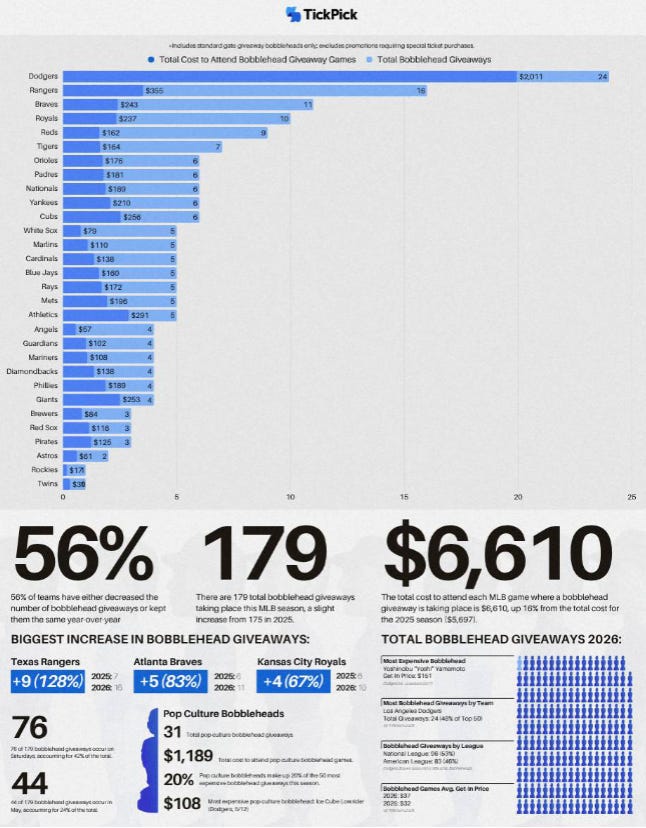
According to the 2026 Bobblehead Report issued by TickPick, the 30 major-league teams issued a combined 179 baseball bobbleheads this year . . .
The Los Angeles Dodgers led the way with 24 bobblehead giveaway days and the total cost to attend each of those games . . .
Tops on the list was a Yoshinobu Yamamoto doll distributed March 31 at a get-in-the-park ticket price of $151 . . .
The team had three Shohei Ohtani bobblehead games — one of them including his dog Decoy — as well as three depicting Yamamoto . . .
Buying tickets to all Dodger bobblehead games would cost a fan $2,011 in ticket purchases, TickPick reported . . .
Following the lead of the World Champions, teams with the most bobblehead days are the Texas Rangers (16), Atlanta Braves (11), Kansas City Royals (10), and Cincinnati Reds (9) . . .
Cincinnati fans could attend all nine bobbleheads in the Queen City for $162.
Know Your Editors
Here’s the Pitch is published daily except Sundays and holidays. Benjamin Chase [gopherben@gmail.com] handles the Monday issue with Dan Freedman [dfreedman@lionsgate.com] editing Tuesday and Jeff Kallman [easyace1955@outlook.com] at the helm Wednesday and Thursday. Original editor Dan Schlossberg [ballauthor@gmail.com], does the weekend editions on Friday and Saturday. Former editor Elizabeth Muratore [nymfan97@gmail.com] is now co-director [with Benjamin Chase and Jonathan Becker] of the Internet Baseball Writers Association of America, which publishes this newsletter and the annual ACTA book of the same name. Readers are encouraged to contribute comments, articles, and letters to the editor. HtP reserves the right to edit for brevity, clarity, and good taste.