
The Coming Defeat of Manager Ejections?
And, never ignore defensive superstars, like one new Hall of Famer

Pregame Pepper
. . . The Shoh Must Go On Dept.—Stop us if you’ve heard this before: Shohei Ohtani hits one out. This time, he sliced a second-inning grand salami to help Team Japan toward a 13-0 burial of Team Taiwan in a World Baseball Classic Pool C game Friday.
. . . Jolly What Dept.—Angels president John Carpino is retiring, to be succeeded by Molly Jolly, who’ll become the first woman to serve as Angels president. Carpino’s role was mostly as a liaison to owner Arte Moreno, with whom Carpino worked since long before Moreno bought the team.
. . . Justice Delayed Dept.—The fraud-and-conspiracy trial of Guardians pitchers Emmanuel Clase and Luis Ortiz has been delayed, with jury selection now scheduled for 2 November. The two pitchers face wire fraud, honest-services wire fraud, bribery, and conspiracy charges in a plot to rig pitches for gamblers’ benefit. The original trial date was 4 May. And a motion to separate the two pitchers’ trials is yet to be decided.
Leading Off
The Coming Defeat of Manager Ejections?
Devoutly to be wished—they and the umps are supposed to be the adults in the room
By Jeff Kallman
“Will [the automated balls-strikes system] kill the managerial ejection?” asks the headline The Athletic attached to Jayson Stark’s examination. Even before I went further to read the piece, my own answer was (and remains) a consummation devoutly to be wished.
I wrote about that very question five years ago. Aside from one or two boilerplate observations (such as people being shocked that career ejection leader Bobby Cox wasn’t thrown out of his own Hall of Fame induction), I said in essence that I’d long run out of patience with the concept of managers going nuclear and to the showers merely to fire their teams up.
“If you’ve got to get yourself sent to your room to fire your players up,” I continued then, “you might consider a different career.” Nothing since has happened to change that part of my mind.
Nor did I let the umpires off the hook. They, too, are presumed to be the adults in the room. Until they’re not. “Lots of umpires cross the line between sound game administration and tyranny for its own sake,” I wrote then.
They behave as though they’re the reason you paid your way into the park or ponied up for a cable television sports package in the first place. It’s absolutely fair to suggest that the [Lou] Piniellas, [Billy] Martins, and [Earl] Weavers had their share of justifiable arguments, if not justifiable tantrums.
Stark only began by asking today’s king of managerial ejections, Yankee skipper Aaron Boone, who insists he’d like to change that status.
“Oh, I’ll still get ejected,” said Boone, whom Yankee fans too often prefer to see ejected from his job, not his dugout. (One bad spring training game: Met fans pronounce a season lost, Yankee fans demand Boone’s execution.) “I’m actually trying not to get ejected. I want to get ejected less. But I’ll still get ejected.”
“I don’t know about never getting ejected,” said Boone’s crosstown counterpart, Mets manager Carlos Mendoza. “But it’s going to be hard . . . At least I think [ABS] will save me some money.” Of all the arguments I have seen for or against Robby the Umpbot, savings never once slipped in until that.
Then came Alex Cora, Red Sox manager, who seems to think Robby won’t make that much difference when it comes to himself and at least one umpire. “I’ll get thrown out—somehow, some way,” he insists. “Laz (Díaz) will throw me out.”
Díaz is accused often enough and with justification enough for being one of the umps I described five years ago (and still believe), thinking he’s the reason you paid through every extremity to take you and yours out to the ballgame.
Other contentious umps may not think they’re the story of any or each game. But it makes them no less guilty of surrendering their adulthoods in the heat of various moments. Some of them have even thrown out the first manager of a game almost “because I can,” if you think about it.
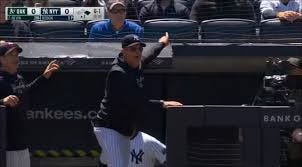
Boone has probably thought about that more than he’d care to admit. It happened to him almost two years ago, when his Yankees hosted the poor, poor, pitiful Athletics for a set. One batter and five pitches in, Boone got the ho-heave from plate umpire Hunter Wendelstedt.
And Boone himself hadn’t said a blessed thing. Sort of.
A’s leadoff hitter Esteury Ruiz was awarded first base when a pitch hit him in the foot. Boone questioned the call, not confrontationally, but television replays showed the hit and Wendelstedt got help from his first base partner John Tumpane. Boone retreated but Wendelstedt gave him what many thought a particularly loud warning.
Then it happened:
That wasn’t an ejection Robby the Umpbot was liable to pre-empt or redress. (Though it might be mad fun picturing Robby trying to eject a skipper: “I don’t care what you didn’t say. You’re gone.”)
Unfortunately, too, Robby isn’t liable to pre-empt or redress fans of worse disposition than the joker who thought nobody would go “boo,” “hiss,” or “You’re gone” when he hollered at Wendelstedt to go home.
The old arguments against replay included the completely nebulous claim that it would delay games unconscionably. That was buncombe then and now. And I still remember the sharpest argument against that argument, from the grand master of baseball broadcasters.
He was calling a game between the Dodgers and the Rockies, in which a close call on a shallow, sinking liner to center field caught on the grass by Rockies center fielder Dexter Fowler sent the Rockies’s manager (a former Dodgers manager) apoplectic:
Uh-oh. Uhhh-oh. The [umpires] meeting looks like they’re going to call it a trap, and Jim Tracy . . . [crowd noise] . . . He caught the ball, Jim says. He caught the ball. He caught the blinkin’ ball. He caught the darn ball . . . [crowd noise, as Tracy pulls his hat off and slams it to the ground two-handed] . . . oh, oh, you’re gone. Heeee’s gone . . . [crowd noise] . . . That is blinkin’ fertlizer! I’m doing the best to translate . . . You’ve gotta be blinkin’ me! . . . The ball, he caught the ball! . . . Unbelievable! Blinkin’ unbelievable! No way! No blinkin’ way! No bloody way!
Jim’s gone, so he’s spending house money now . . . [crowd noise] . . . [brief, slow-motion replay of the outfielder’s original attempted off-the-grass catch] . . . take another look, looks like it’s in the glove . . . what’s a shame, really, we have this [replay] equipment, and no one takes avail of it. I mean, they say it would slow up the game, what did that do? I mean, they could have had someone upstairs, or an umpire go and look at the tapes. Instead, big argument, the manager’s kicked out of the game, the umpires have to reverse . . .
Stark couldn’t resist hoisting a table showing Boone as the number two man among active managers for ejections, with 46. Only Terry Francona’s 54 are higher. Francona compiled his over 24 years worth of managing. Boone did his in eight. Francona’s averaging two purges a season, Boone six.
“You can book this. I will not break Bobby Cox’s record,” Boone insists to Stark. “I’m trying to be more well behaved.” You can just hear Lou Piniella’s partisans fuming, Wimp!!!
That’s Lou Piniella, the man whose “animation” (har, har) was such that even his supporters thought his managerial academy would have to include course work and testing for dirt kicking, hat throwing, base throwing, wind sprints up and down the base lines, maybe with Cox as one of his department chairs.
Piniella delivered a “classic,” if we must call it that, during a nationally televised game, throwing his hat, kicking some dirt, and running those sprints before and after he got the thumb. “I’m forty-four years old,” his wife lamented, since it happened on her birthday, “and I’m married to a four-year-old.”
Precisely the point. Let Robby the Umpbot succeed in compelling the Boones and the Wendelstedts into being the adults in the room they’re supposed to be. (Gil Hodges, call your office.) It’ll be the greatest favour baseball’s been done since the demise of the most guaranteed outs in the lineup.
Jeff Kallman edits the Wednesday and Thursday editions of Here’s the Pitch. He lives and works in Las Vegas. You can reach him at easyace1955@gmail.com or easyace1955@outlook.com.
* “That is blinkin’ fertilizer” became almost as fabled a Scully call as his calling Henry Aaron’s 715th career home run. But it also secured a point. Technology isn’t the enemy.—Ed.
Cleaning Up
Andruw’s Glove Made Him a Hall of Famer
By Dan Schlossberg
Five outfielders in baseball history won at least 10 consecutive Gold Gloves.
Four are in the Hall of Fame: Ichiro, Willie Mays, Roberto Clemente, and Ken Griffey, Jr.
The fifth will join them this July.
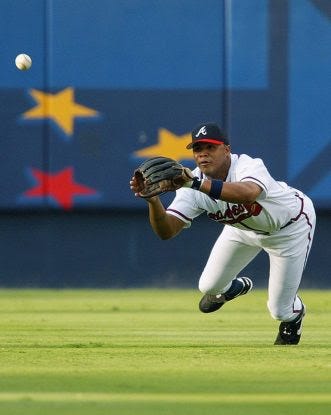
By all accounts, Andruw Jones may have been the best defensive outfielder in baseball history — at least during the decade of his peak years, starting at age 19. He still outranks everyone, Mays included, in defensive runs saved and other key categories.
He was to outfielders what Ozzie Smith was to infielders: the best.
Like the long-time Atlanta star, Ichiro won 10 Gold Gloves in his first 10 seasons. Because he led the majors in hits seven times — one of them when he cracked a record 262 in a single season — his fine fielding and rifle arm from right field cannot be overlooked. And he was already 27 when the U.S. side of his career began.
Al Kaline took 10 Golds too but not in succession. He was also a batting champ and an 18-time All-Star. A star of the ‘50s, he was Griffey Junior before Griffey.
Mays and Clemente combined for a dozen Gold Gloves, tops among outfielders. The former won two MVPs and a batting title, led the majors in steals three times, and hit 660 home runs. But the picture of Mays shown most often is the Polo Grounds back-to-the-plate catch against Vic Wertz in the 1954 World Series opener.
As of Clemente, who lost his life in a plane crash immediately after collecting his 3,000th hit, he might have won more than 12 Golds had he continued to play. But he was 38 when his relief plane went down en route to Nicaragua after an earthquake.
The only infielders with at least 10 Gold Gloves are first baseman Keith Hernandez (11) and second baseman Roberto Alomar (10), both of whom played for the Mets and other teams. Hernandez is hanging around as a broadcaster in Flushing and may yet convince the Eras Committee to send him to Cooperstown.
Alomar, on the other hand, could be headed the other way. Already disbarred by the Blue Jays, who unretired his retired number after sexual charges surfaced, the 12-time All-Star was a dynamic middle infielder until the end of his career. He could hit too.
Speaking of hitting, Mike Schmidt had 548 home runs and three MVP trophies to accompany his 10 Gold Gloves at third base. He spent his entire career with the Phillies, for whom he won eight NL home run crowns.
Fellow third baseman Nolan Arenado somehow won 10 Gold Gloves even after opening his career with the altitude-challenged Colorado Rockies in Denver. He didn’t hit like Schmidt but didn’t hit like Ozzie Smith either.
Smith actually made the All-Star team three times more often than Schmidt, who was sent a dozen times. The star shortstop of the St. Louis Cardinals won 13 Gold Gloves and loved to show off a penchant for somersaults.
Like The Wizard of Oz, Omar Vizquel could not only win games with his shortstop skills but also with his agility on the basepaths. He won 11 Gold Gloves while stealing more than 400 bases (Ozzie had 580). His bat and his off-the-field conduct presumably kept him out of Cooperstown after a brief boomlet fizzled.
Brooks Robinson, on the other hand, was the epitome of perfection on and off the field. He won 16 Gold Gloves, an RBI crown, and an MVP award — all for the Baltimore Orioles. No position player won more.
One man did, however: pitcher Greg Maddux, a lifetime National Leaguer, won 18 Gold Gloves, the record, while winning 355 games, more than any living pitcher. American Leaguer Jim Kaat won 16 straight, second among pitchers, but Maddux was a master — a fifth infielder whose defense saved many of his own games.
Maddux always banked heavily on good batterymates, from Charlie O’Brien to Eddie Perez. But he never had the privilege of throwing to Johnny Bench or Pudge Rodriguez, both Hall of Fame backstops.
Bench, who had enormous hands, was probably the best-hitting catcher of all time, though Roy Campanella and Yogi Berra might argue. The long-time Cincinnati star won two MVPs and went to 14 All-Star Games while winning 10 Gold Gloves.
Rodriguez was even more of a golden boy, winning the defensive trophy 13 times. He also won MVP awards for the regular season and World Series. But he couldn’t match the Bench power production and only once reached 35 long balls.
HtP weekend editor Dan Schlossberg of Fair Lawn, NJ covers baseball for forbes.com, USA Today Sports Weekly, Sports Collectors Digest, Memories & Dreams, and Here’s the Pitch, among others. His email is ballauthor@gmail.com.
Extra Innings: They Said It, We Didn’t
Atlanta isn’t totally blameless in this mess. Profar’s deal, which could go down as one of the worst free-agent contracts in history, was met with a healthy dose of skepticism the moment it happened. There was a certain buyer-beware element. Still, it’s not like the Braves could have drug-tested him themselves before he inked it. They are as powerless now as they were when they signed him.
Any change to the current penalty system — 80 games for first-time offenders, a full season for second-time offenders and a lifetime ban for the third — would have to be collectively bargained for and agreed upon by the commissioner’s office and the players’ association. In previous CBA negotiations, commissioners tried to modify existing rules to allow teams with multiple offenders the ability to void contracts, particularly when the violating player had recently signed a multiyear deal.
—Brittany Ghiroli, The Athletic, on Jurickson Profar’s second suspension for actual or alleged performance-enhancing substances.
I think there’s a fear of missing out on the United States’ side. And my talks in recruiting the players were a heck of a lot different this time around than in 2023.
I just feel like there’s been a tidal wave of emotion, kind of wanting to win this thing. And I think guys like Logan [Webb], guys like Paul Skenes, from a pitching perspective, were very adamant about wanting to be here.
—Mark DeRosa, Team USA manager, whose squad is considered the favourite at this writing to win the 2026 World Baseball Classic.
Last Licks . . .
This is not Casey Stengel requiring restraint before trying to deck, drop, or decapitate an umpire . . .
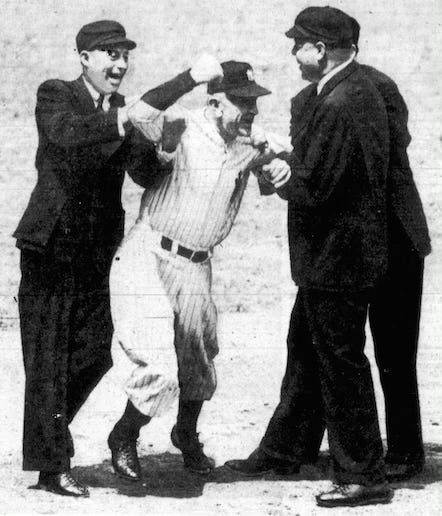
That was actually the umpires in on the gag as the Yankees prepared to wheel a birthday cake out to honour their skipper on one of his birthdays.
Know Your Editors
Here’s the Pitch is published daily except Sundays and holidays. Benjamin Chase [biggentleben@hotmail.com] handles the Monday issue with Dan Freedman [dfreedman@lionsgate.com] editing Tuesday and Jeff Kallman [easyace1955@outlook.com] at the helm Wednesday and Thursday. Original editor Dan Schlossberg [ballauthor@gmail.com], does the weekend editions on Friday and Saturday. Former editor Elizabeth Muratore [nymfan97@gmail.com] is now co-director [with Benjamin Chase and Jonathan Becker] of the Internet Baseball Writers Association of America, which publishes this newsletter and the annual ACTA book of the same name. Readers are encouraged to contribute comments, articles, and letters to the editor. HtP reserves the right to edit for brevity, clarity, and good taste.
I think managers amuse themselves when they get themselves thrown out of a game. Umpires like throwing them out as both parties feel it's a tie to the early days of the game. But as Jeff notes, it doesn't make baseball better.
Maybe it doesn't make baseball "better," but it still makes it baseball. Like the catcher throwing the ball to third after a strikeout with no one on base.
They do it because they do it. I'm not interested in change to make the game more "efficient."