
Cracking Long-Standing Diamond Marks May Be Mission Impossible
PLUS: EXPANDED PLAYOFF SYSTEM RUINS FUN OF TRADE DEADLINE

Readers React
ON ALL-STAR MEMORIES:
“Thanks for another great issue, and your All-Star games list was excellent.
Here’s a quick note on the 1934 All-Star game in which Carl Hubbell K’d in order: Ruth, Gehrig, Foxx, Simmons, and Cronin.
What’s never mentioned about Carl’s K streak is that the Yankee’s Bill Dickey broke the streak with a single, and then Hubbell K’d the Yankee’s Lefty Gomez to strike out the side in consecutive innings. As Casey would say, “You could look it up.”
I met both Carl and Lefty in 1963. Former Giant and Brave Buddy Kerr introduced me to Carl on a road trip to York, PA. I met Lefty at a 1963 minor league All-Star Game.”
— Wayne Coleman, Atlanta
ON MICHAEL HARRIS II ENDORSEMENT:
“You got this one all wrong…but I can forgive your Braves homerism.
First, Zach Wheeler is the biggest NL snub, bar none. Amazing stats, back from potentially career-ending injury, game being played in his home park. Sorry, Mike.
As for Harris II, ahem…
Harris: .304/.335/.503, with 16/45, 322 ABs, 2.8 bWAR (2.3 oWAR, 0.7 dWAR), 129 OPS+
PCA: .296/.387/.543, with 20/52, 348 ABs, 5.7 bWAR (4.6 oWAR, 1.4 dWAR), 159 OPS+ (+ 23 stolen bases)
Wood: .269/.402/.546, with 25/61, 357 ABs, 3.7 bWAR, 162 OPS+
Soto: .297/.414/.579, with 21/50, 266 ABs, 3.1 bWAR, 175 OPS+
He is most certainly NOT the best center-fielder (or outfielder) in the National League.”
— Dan Freedman, Santa Monica, CA
The writer is one of the editors of Here’s the Pitch.
Pregame Pepper
After missing more than a month with a hamstring issue, former MVP Ronald Acuña, Jr. is working his way back to the Braves with a minor-league rehab assignment . . .
He hit a grand-slam in his third rehab game . . .
Three-time batting champion Luis Arraez is much more valuable as a San Francisco trade chip now that he’s mastered the art of playing second base (thanks to Ron Washington) . . .
A low payroll did not stop the upstart Marlins from creeping to within four games of first place in the NL East at the All-Star break . . .
With baseball now a sport in the 2028 Olympics, MLB wants chosen players to participate — even if it means a three-week break in the middle of the season.
Leading Off
Baseball’s Unbreakable Records
By W.H. Johnson
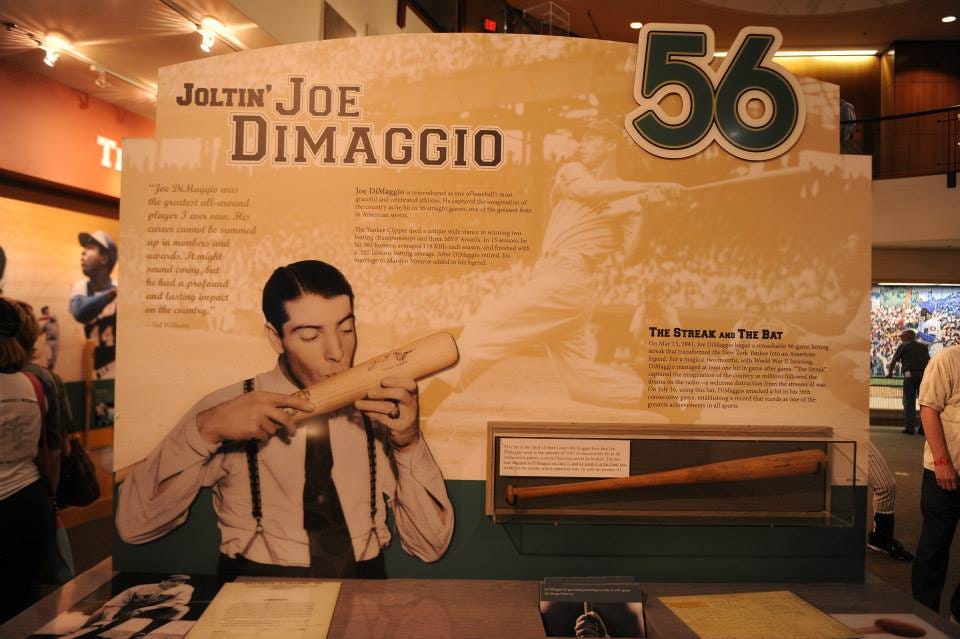
It was four score and five years ago today that one of the landmark records in baseball’s history was set — when Joe DiMaggio’s 56 consecutive-game hitting streak came to an end.
Between May 16 and July 16, 1941, DiMaggio batted .408 and obliterated the previous consecutive-games hit streak of 44, a mark that had stood since 1897. On this day in 1941, however, at Cleveland’s Municipal Stadium, Tribe third-baseman Ken Keltner made two brilliant stops, and Lou Boudreau fielded a last-gasp, ninth-inning grounder to end DiMaggio’s incredible record-setting streak at 56.
The anniversary of the end of that streak raises the question, “Will it ever be broken?”
The answer is very likely “no.” Unless the rules and patterns of baseball change and eliminate the rocket-armed relievers who almost always close out the final innings of games, the likelihood of anyone hitting safely in 57 consecutive games approaches ‘zero.’ Given the state of the game, there are several marks that may as well be chiseled into baseball immortality, as there is no viable path that anyone could follow to actually break the records.
Along with the consecutive-game hitting streak, Cy Young’s 511 pitching wins is perhaps one of the safest in the record books. The de-emphasis on pitching wins and starter endurance [the reduction in innings pitched by starters over the last few decades] all but ensure that Young’s career total is unapproachable. Walter Johnson’s second-place total of 417 wins is, similarly, as safe as Young’s mark.
In fact, the annual pre-season speculation about who, if anyone, might approach even 300 victories indicates that the top 20 on the list will remain there eternally unfulfilled until the rules change. This is neither an attack on, nor defense of, pitching wins as a valuable statistic. But the record exists, and it is safe.
Perhaps even safer is the career complete-games mark. The record again belongs to Cy Young, with 749. For perspective, per Baseball-reference.com, Justin Verlander [26], Chris Sale [16] and Sandy Alcantara [13] are the current active leaders in the category. The volume-statistical records of the previous century, especially on the pitching side, appear safe. For a final untouchable, add Walter Johnson’s 110 career shutouts. Verlander again leads active pitchers with nine, and the next five have five apiece.
The predominant shift to five-man [or more] pitching rotations, bullpen usage, defensive positioning metrics, emphasis on player rest, and the evolution of the collective offensive emphasis on swinging for fly balls all aggregate to create an environment in which not even the most optimistic observer can legitimately believe the above-discussed records can ever be approached.
But, what baseball taketh away, it also giveth. The same conditions cited for pitching record protection make some batting marks that were previously considered unattainable by many are now very much in play.
The first two marks that could fall, perhaps in this decade, are Hack Wilson’s 191 RBI in a single season, and Barry Bonds’ 73 home runs in the same time-frame. The 1930 season opened what has come to be known as a ‘lively ball’ era, when a number of players in both leagues set about elevating offense to levels never seen before in the game’s history. Wilson set his record that year, and not even the star sluggers of the era, Hank Greenberg and Jimmie Foxx, could get close.
That the offensive explosion coincided with increased fan interest, even in the shadow of the Great Depression, and demonstrated to executives and writers alike that higher-scoring games, with more balls in play, represented a type of baseball that could produce profit. The universal truth of professional sports, demonstrated daily even in 2026, is that investors love profit. More than trophies, the bottom line is always at the top of the priority list.
Thus, the rules have slowly bent to accommodate even more offense. Despite the scandal of the steroids era, attendance and fan enthusiasm only grew. Old-school purists decried the villainy of performance-enhancing drugs in the game, but the ooohhs and aaahhs accompanying a McGwire or Sosa or Bonds blast largely drowned out the former. As the ad campaign immortalized, “Chicks dig the long ball.”
Along with the two slugging records, Ichiro Suzuki’s 262 hits in a single season could be in play as well. This may seem inconsistent, since previous paragraphs argued against the chances of anyone breaking the consecutive game hit streak mark, but over the course of a season there may be quasi-unicorn player who can exploit the current pitching philosophy and the associated reliance on velocity over guile, who can hit 100 mph fastballs while recognizing tunneled sliders and sweepers, and average a hit-and-a-half per game for an entire season. This is not to argue that it is likely, but it is far more imaginable than anyone throwing 16 shutouts in a season, much less 110 in a career.
Finally, and this is submitted even in recognition of the substantial role of bullpens throughout the game, Johnny Van Der Meer’s two consecutive no-hitters could be equaled. Likely not broken, but equaled. The willingness of hitters to eschew soft contact in exchange for the chance to ‘do damage’ cannot be ignored. The approach induces vulnerabilities. There are some brilliant, talented pitchers on big-league rosters, in the minor league systems, and growing up in the game around the world who may be able to exploit those figurative holes. Someday, someone may well tame the slugging machine twice in a week.
Such events are never likely, but certainly not impossible.
Bill Johnson has contributed over 50 essays to SABR’s Biography Project and presented papers at the 2011 Cooperstown Symposium on Baseball and American Culture, the 2017 and 2023 Jerry Malloy Negro League Conferences, and the inaugural Southern Negro League Conference. He has authored a biography of Hal Trosky (McFarland and Co., 2017), an article about Negro American League All-Star Art “Superman” Pennington in the journal Black Ball, and publishes a Substack newsletter “Baseball Marks the Time” among his various outlets.
Cleaning Up
Pie-in-the-Sky Playoff Hopes Dampen Trade Deadline
By Dan Schlossberg
The worst thing about the wild-card playoff system is its destructive effect on the trade deadline.
Too many teams think they can hang on — both in the standings and on their rosters — and thus refuse to trade veterans for prospects at deadline time.
That kills the whole purpose of trading and severely jeopardizes fan interest in the game.
As the second half opened, there were 23 teams — including eight that stood under .500 — within hailing distance of a playoff spot.
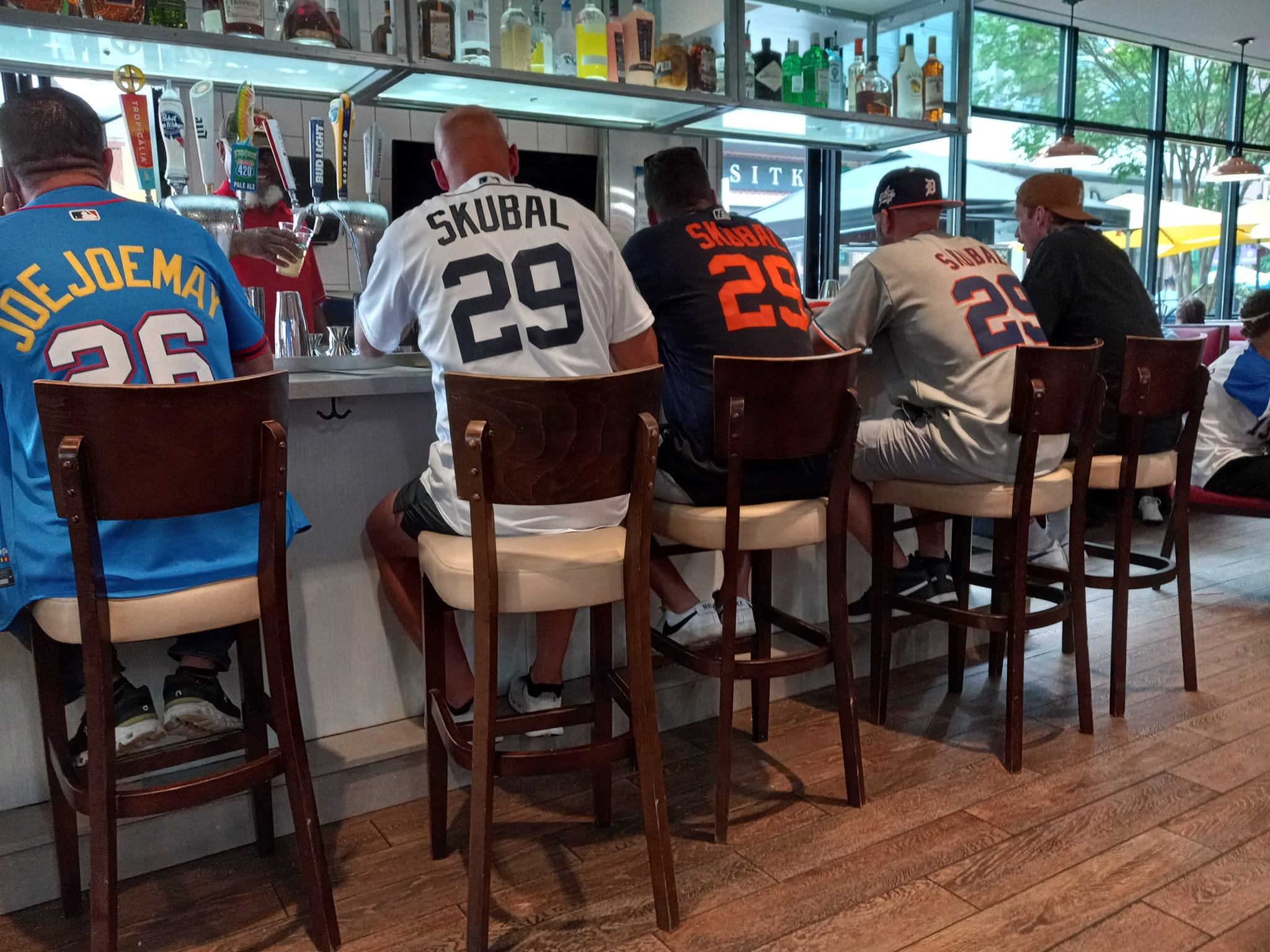
After hinting that impending free agent Tarik Skubal is trade bait, the Detroit Tigers are avoiding the vultures who seek to pry him loose from a team that started poorly but played better lately.
Even the Boston Red Sox, cellar-dwellers for most of this season but taking a nine-game winning streak into the All-Star break, suddenly see a slim shot at a post-season berth — and may sit on their players rather than rebuild.
Ditto the San Francisco Giants, who openly talked of dumping salaries before the Aug. 3 deadline, but now may just keep Rafael Devers, Willy Adames, and Matt Chapman in the unjustified hope that there’s a secret elixir in the four-day All-Star hiatus from regular-season games.
Hey, Craig Breslow: there isn’t.
Ironically, the first significant swap of the 2026 deadline season involved a long-time Houston Astros starting pitcher whose hefty price tag does not jive with his perpetual residence on the injured list. The Milwaukee Brewers, worried about Brandon Woodruff again, agreed to take on the money and the arm in the hope Lance McCullers, Jr. can still pitch.
Almost all general managers agree that the more teams that sit on their hands means that the price of all truly available pitchers goes up. The Laws of Supply and Demand are also at work here: as stand-pat teams increase, the price rises on pitchers who actually could be moved (see Freddy Peralta, Robbie Ray, Patrick Corbin, and Michael Wacha, among others).
Even though Skubal, Sonny Gray, and Mason Miller might not be going anywhere, the cost of landing a Casey Mize, Joe Ryan, Luis Castillo, or Sean Manaea has suddenly become prohibitive.
Atlanta radio guy Kevin Barnes, aware of the problem, suggests the trade deadline is too early. Move it back to mid-August, he says, and more teams would know whether to buy or sell.
An observer of the big-league scene for more than half-a-century, Barnes has an idea that should be a no-brainer for Rob Manfred and his minions.
Major League Baseball has had no qualms about changing the rules regarding extra innings, infield shifts, pickoff throws, and a myriad of other traditional concepts. Changing the trade deadline — or do anything to facilitate deals — would be good for the game.
HtP weekend editor Dan Schlossberg of Fair Lawn, NJ used to live or die with the trade deadline. Now he just yawns. Email him at ballauthor@gmail.com.
Extra Innings: All-Star Post Mortem
The AL pitched the 10th shutout in All-Star Game history and the first in 13 years, since AL beat the NL, 3-0, at CitiField in New York in 2013. Angels outfielder Mike Trout led off for the winning American Leaguers in both games . . .
When Yankees stars Cody Bellinger and Ben Rice hit RBI singles against NL starter Cristopher Sánchez in the first, they became the first pair of Yankees teammates to record All-Star RBIs since Roger Maris and Tom Tresh in 1962 . . .
Bellinger was All-Star Game MVP, an honor won previously by Yankee All-Stars Giancarlo Stanton (2022), Mariano Rivera (2013) and Derek Jeter (2000) . . .
When Dodgers lefty Justin Wrobleski pitched in the All-Star Game on his 26th birthday, he became the ninth man to celebrate his special day by playing in an All-Star Game, joining Justin Steele (2023), Howie Kendrick (2011), Yadier Molina (2010), Jeff Shaw (1998), Robin Ventura (1992), Andre Dawson (1990), Ted Simmons (1981) and Billy Herman (1936-37) . . .
The only home run of the game, a 433-foot shot by Miguel Vargas in the eighth, made him the third White Sox player with an All-Star Game homer, following Magglio Ordoñez in (2001) and Frank Thomas (1995) . . .
At least the 2026 Midsummer Classic, which turned out to be more like a midsummer snooze, did not deadlock after nine innings — saving the game and its fans from the ridiculous in-game Home Run Derby to decide which league won.
Know Your Editors
Here’s the Pitch is published daily except Sundays and holidays. Benjamin Chase [gopherben@gmail.com] handles the Monday issue with Dan Freedman [dfreedman@lionsgate.com] editing Tuesday and Jeff Kallman [easyace1955@outlook.com] at the helm Wednesday and Thursday. Original editor Dan Schlossberg [ballauthor@gmail.com], does the weekend editions on Friday and Saturday. Former editor Elizabeth Muratore [nymfan97@gmail.com] is now co-director [with Benjamin Chase and Jonathan Becker] of the Internet Baseball Writers Association of America, which publishes this newsletter and the annual ACTA book of the same name. Readers are encouraged to contribute comments, articles, and letters to the editor. HtP reserves the right to edit for brevity, clarity, and good taste.