
Catchers Get Extra Credit In MVP Vote (Part 2)
PLUS: GREAT HALL OF FAME PHOTO ARCHIVE STARTS 2026 JOURNEY

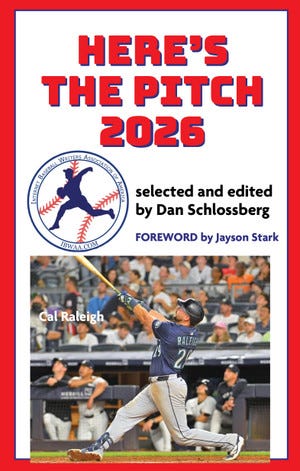
THE FIRST 2026 BASEBALL BOOK — CLICK HERE TO ORDER:
https://actapublications.com/here-s-the-pitch-2026
Reader Reacts to Sporting News In Print
“If some innovative baseball journalists got the funding, perhaps a newsprint/online version of this great publication could return. One key front page element was those precisely-illustrated cartoon images. Don’t know if there are young illustrators who could step up with that skill.”
— Jim Rowbotham, Manhattan
Pregame Pepper
Nine teams topped MLB’s competitive balance tax (CBT) in 2025 for the second year in a row . . .
According to Roster Resource, teams with payrolls above $281 million included the Dodgers ($417 million), Mets ($347 million), Yankees ($320 million), Phillies ($314 million), and Blue Jays ($286 million) . . .
The combined payroll and tax bill for the 2025 Dodgers topped $586 million, with the tax alone greater than the payrolls of the bottom dozen teams combined . . .
Teams that had payrolls below $100 million were the Miami Marlins ($87 million) and Chicago White Sox ($92 million), with the Rays, Pirates, and Athletics completing the bottom five in payroll rankings . . .
The Dodgers surrendered their second and fourth-round amateur draft picks for signing former Mets closer Edwin Diaz . . .
San Diego, which lost Dylan Cease to Toronto, and the Mets both get an extra pick after the fourth round because their stars signed elsewhere.
Leading Off
MVP Extra Credit for Catchers (Part II)
By Paul Semendinger
In my analysis of MVP voting, I discovered that catchers often receive extra credit. It seems that when catchers have good-to-great years, they earn extra-credit votes. That is especially true if the catcher is on a pennant-winning team - even if he had teammates who had superior statistical seasons. The trend to award catchers “extra-credit” has occurred almost as long as the MVP has been awarded.
This article is Part 2 of 2 (1980-2025) examining catchers and the MVP Vote:
1982
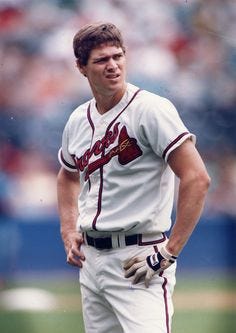
In the history of the awarding of the MVP Award, the National League winner should have been a catcher, as was not. In 1982, Gary Carter of the Expos led the N.L. in WAR (8.6) and was significantly better than the winner, Dale Murphy (6.1).
Looking at their statistics:
Carter: .293/29/97
Murphy: .281/36/109.
It seems as though the Braves winning the N.L. West (the Expos were a third-place team) and the fact that Dale Murphy led the league in games and runs batted in tilted the scales in his favor.
This was the first time that a catcher who deserved the award was not recognized.
1982-1998
The late 20th century was a period that did not see catchers performing at the top of the game in regard to overall performance, and neither did catchers receive much, if any, extra-credit.
Mike Piazza, a great catcher in this era, received MVP votes in eight seasons and was the runner-up twice (1996 and 1997) along with some other top finishes:
1994 - 6th place in MVP, 13th in WAR
1995 - 4th place in MVP, 5th place in WAR
1996 - 2nd place in MVP, 14th place in WAR
1997 - 2nd place in MVP, 4th place in WAR.
While he didn’t win the award, he did seem to earn extra-credit.
Gary Carter should have won the MVP in 1982. He received MVP votes in six seasons from 1980 on. Three times, he was a Top 10 finisher:
1981 - 6th place in MVP, 8th in WAR
1985 - 6th place in MVP, 6th in WAR
1986 - 3rd place in MVP, 14th in WAR
It seems he was accurately awarded in 1981 and 1985 and received some extra credit for being a catcher on the pennant-winning Mets in 1986.
Carlton Fisk did not receive much MVP consideration from 1980 on receiving votes in only three seasons. In 1983, his vote total (3rd place) defied his actual performance (15th best WAR).
1999
Maybe the writers wished to revert back to an old habit as a new century was dawning.
Ivan Rodriguez, who had the 6th best WAR in the American League, won the MVP. The position player with the highest WAR in 1999 was Derek Jeter (8.0). Pedro Martinez (9.8) led the league in WAR.
2009
The American league MVP was Joe Mauer who put up a nice season: .365/28/96. He led the league in batting, on base percentage, and slugging percentage. Mauer was third in WAR (second among position players) behind Zack Greinke (10.8) and Ben Zobrist (8.6).
Zobrist batted .297/27/91.
Awarding the MVP to Mauer was the correct decision.
2012
It is possible that more and more writers began to embrace some of the newer statistics that they selected more and more worthy candidates for MVP, at least in this exercise, if we’re looking at catchers.
In 2012, Buster Posey led the National League in WAR as he hit .336/24/103 with 7.6 WAR. His .336 led the N.L. Posey was correctly named the MVP.
2025
Aaron Judge won the MVP, but catcher Cal Raleigh had an impressive season of his own. Judge dominated most statistical categories, including WAR toping Raleigh convincingly 9.7 to 7.4. Raleigh, who led the American League in homers and runs batted in, was second in WAR and in the MVP voting.
Conclusion
There still seems to be a tendency of voters to look to the “field general,” the catcher, as a player deserving of the MVP, though that lessened over the last many decades. When the final votes are calculated, in recent years, the extra-credit catchers used to receive much more often has lessened.
A follow-up study looking at the highest ranked catcher in MVP voting would be interesting to see to note if that player received votes primarily due to his position.
This author is also interested to see how often the voters’ MVP choices were correct if one were look back just at WAR totals.
Paul Semendinger has written a plethora of great books. Check out West Point at Gettysburg, Vol. 1. It’s a winner!
Cleaning Up
Hall of Fame Photo Exhibit Hits The Road
By Dan Schlossberg
Underlining the adage that a picture is worth 1,000 words, the Baseball Hall of Fame is just five days away from launching the 2026 version of its traveling photographic road show.
Called Picturing America’s Pastime: A Snapshot of the Photographic Collection at the National Baseball Hall of Fame and Museum, it features 51 framed photographs — a microscopic portion of the quarter-million images in the famed Cooperstown collection.
Featured photographers include Charles M. Conlon, Carl J. Hoprner, Arthur Rothstein, William C. Green, and Brad Mangin, along with many others whose work has found its way into the museum’s archives. The pictures range from sepia to black-and-white and full color.
Ironically, the first stop on this year’s tour is Maysville, a Kentucky town not named for the iconic Hall of Famer whose name it bears.
It will be a great add-on for visitors to the 2026 Kentucky Derby at Churchill Downs in Louisville on May 2.
After a month in the Kentucky Gateway Museum Center, the elaborate show will move to the Haggin Museum in Stockton, CA (April 6- May 31) and the Upcountry History Museum at Furman University in Greenville, SC (June 20-Oct. 25).
Its two-month stay in Kentucky will end on March 15, coincidentally the Ides of March.
Museums and locales were chosen because the Hall of Fame seeks to expand awareness of the sport regionally — especially into areas that are or were homes to minor-league baseball.
Located in the Central New York hamlet of Cooperstown, the Baseball Hall of Fame opened for the first time on June 12, 1939. Its Class of 2026 will be inducted on July 26 at Clark Sports Center. That class will include Jeff Kent, chosen by the Contemporary Players Eras Committee, and anyone chosen by the Baseball Writers Association of America, to be announced Jan. 20. Favorites are Carlos Beltran and Andruw Jones.
HtP weekend editor Dan Schlossberg of Fair Lawn, NJ covers baseball for forbes.com, Here’s the Pitch, USA TODAY Sports Weekly, Sports Collectors Digest, and anyone else who asks. His email is ballauthor@gmail.com.
Timeless Trivia: on No-Hitters — or Not
No-hitters are disappearing into the dustbin of history.
Except for 2025 and the virus-shortened 2020 season, there had been at least one no-hitter in 33 of the last 35 seasons — the most in any 35-year span . . .
The last year without a no-hitter was 2005 . . .
The Dodgers, despite their star-studded pitching staff, once finished on the wrong end of no-hitters twice in three days — and both times in the ninth inning or later . . .
Hall of Famer Nolan Ryan, who pitched a record seven hitless games, lost two more no-hit bids in the final month of the 1989 season . . .
Future Hall of Fame manager Dusty Baker pulled pitchers throwing no-hitters a dozen times, three more than runner-up Craig Counsell . . .
Seven times since 1900, seasons without no-hitters had at least one in September.
Know Your Editors
Here’s the Pitch is published daily except Sundays and holidays. Benjamin Chase [gopherben@gmail.com] handles the Monday issue with Dan Freedman [dfreedman@lionsgate.com] editing Tuesday and Jeff Kallman [easyace1955@outlook.com] at the helm Wednesday and Thursday. Original editor Dan Schlossberg [ballauthor@gmail.com], does the weekend editions on Friday and Saturday. Former editor Elizabeth Muratore [nymfan97@gmail.com] is now co-director [with Benjamin Chase and Jonathan Becker] of the Internet Baseball Writers Association of America, which publishes this newsletter and the annual ACTA book of the same name. Readers are encouraged to contribute comments, articles, and letters to the editor. HtP reserves the right to edit for brevity, clarity, and good taste.
The comment “with the tax alone greater than the payrolls of the bottom dozen teams combined” is not correct. The Dodgers’ tax is higher than each of the bottom dozen teams individually, not combined.