
Review Of 'A House Divided'
ALSO: PROS AND CONS COLLECTED OVER HALF A CENTURY

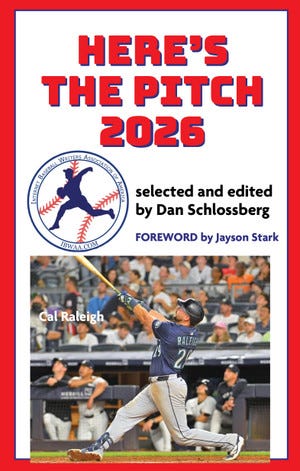
THE FIRST 2026 BASEBALL BOOK — CLICK HERE TO ORDER:
https://actapublications.com/here-s-the-pitch-2026
SABR Analytics Research Awards voting is open through February 6! Vote for your favorite analytical baseball research and commentary from 2025. Everyone is welcome to vote to determine the winners. You can vote each day at ibwaa.com/sabr-voting.
Pregame Pepper
Goodbye and good luck to veteran reliever David Robertson, who came up empty in the free-agent market at age 41 . . .
Makes one wonder whether the same fate will force fellow 40-somethings Max Scherzer, Justin Verlander, and Justin Turner to follow suit . . .
Although the Giants struck out in their pursuit of Washington shortstop CJ Abrams, San Francisco succeeded in patching up its defense by persuading free-agent center-fielder Harrison Bader to come west . . .
Seeking another experienced lefty to pair with Chris Sale, the Braves decided to take a flyer on Martín Pérez, a Venezuelan who relies on deception rather than velocity . . .
Though still waiting on his call from the Hall, Keith Hernandez remains the only first baseman ever to win at least 10 Gold Gloves . . .
Both Ichiro and Andruw Jones won their 10 straight Gold Gloves in their first 10 seasons . . .
The Braves 400 Club has an All-Star guest list as its annual banquet tonight, with just-retired manager Brian Snitker to be honored before Braves icons Brian McCann, Tim Hudson, Chris Sale, Charlie Morton, Ned Yost, Bruce Benedict, Glenn Hubbard, and broadcasters Paul Byrd and Kelly Crull, who will co-emcee . . .
Happy Erev Groundhog Day! Braves pitchers and catchers report a week from Monday. It’s about time!
Leading Off
A review: The House Divided
By Andrew Sharp
J.B. Manheim, a retired professor of political communication at George Washington University and an IBWAA member, is the author of, among other titles, The Deadball Files, six works of political fiction set in events that took place in the years 1900-1920. His most recent effort in several ways is stranger than fiction, yet in others resonates in today’s politics.
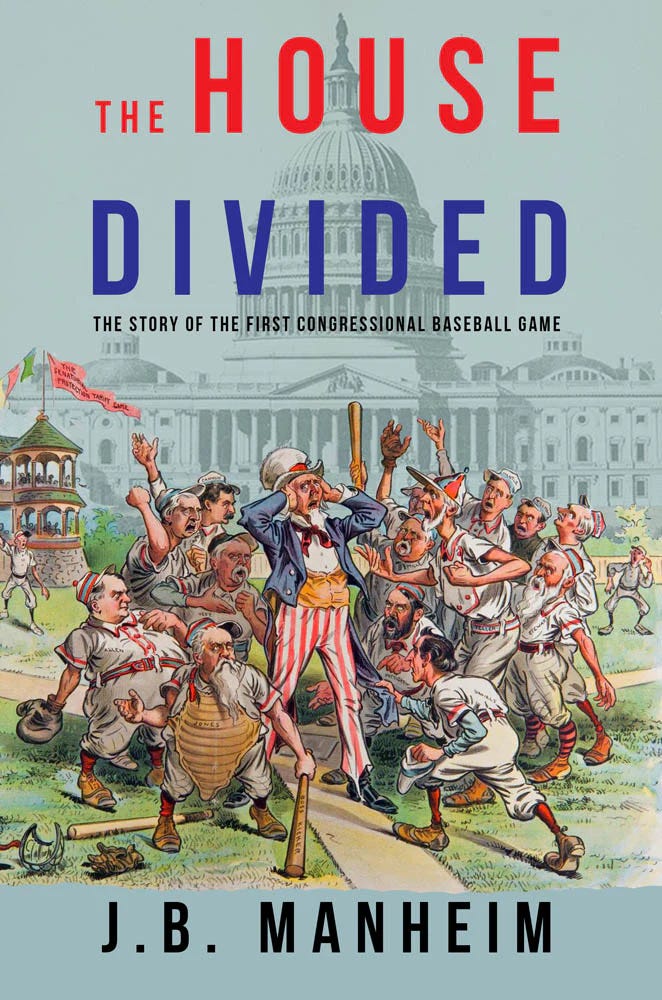
The House Divided, subtitled The Story of the First Congressional Baseball Game and published by Sunbury Press in 2025, is about much more than just the first such baseball game in 1909. Its two main themes are the roles played by the all-powerful House Speaker Joseph Cannon in increasingly protectionist tariffs and the far lesser part played by freshman Representative John K. Tener, the man widely credited with organizing the first congressional game.
Mainheim’s lengthy discussion of Tener takes a contrarian view of Tener’s involvement, other than as a player himself. Tener actually had been a pitcher with with the Chicago White Stockings in the National League before running for Congress. (He was the Republican team’s shortstop in the game.) His lone term in Congress, during which he missed 62 percent of the votes, was seen as a stepping stone to running for -- and being elected -- governor of Pennsylvania. He later served as president of the National League.
Manheim sees Tener as “less the driving force behind the game than a convenient and suitably credentialed and skilled agent for others who saw its potential benefits.” The House Divided is a wide-ranging story of the part the congressional baseball game played in political games played out in backrooms. Or, in one significant instance, on a bumpy road trip in three automobiles of the day to a minor-league baseball game in Baltimore.
The idea of a relatively perilous trip by a high-level congressional delegation to Baltimore is viewed by Manheim as in part a strategy-plotting session away from preying eyes and eager ears of others in Washington. Tener knew Orioles owner Ned Hanlon from their playing days and was asked to have Hanlon invite the congressmen to a game.
The anti-tariff progressives of the day, a mix of Republicans and Democrats, were led to believe the House bill they backed would foster free trade. Cannon and his allies portrayed the bill as doing that, while his real goal was the opposite. The speaker went as far as to express support for a constitutional amendment to allow an income tax to replace lost tariff revenue, convinced that it would never win approval in the states. Be careful what you wish for.
Animosity in Congress was reaching a boiling point over what was happening – or not happening. Cannon in effect halted all House business – as the Senate emasculated the tariff reduction bill. The idea of what would be seen as a bipartisan baseball game was in Manheim’s view a way to reduced tensions.
The political machinations are supplemented by a plethora of Manheim’s side trips into D.C. baseball history, the most extensive of which is a detailed chapter on the various sites used by professional teams that have played in Washington.
Manheim’s work, extensively end-noted, is a well reasoned argument that Tener was unlikely to have come up with the idea for the first congressional game, nor was he heavily involved in organizing it. Beyond that, however, readers who love both baseball and political history will learn a lesson that seems to have eluded one present-day potentate.
Cannon soon was stripped of much of his power as a bipartisan group of reformers made major gains. The Republicans even lost their majority in the House in the fall of 1910, likely based at least in part on voter displeasure with the effect of higher tariffs.
The congressional baseball games have continued on and off since 1909. There is now a website devoted to the games, which have raised millions for the various charities they support. For those interested in the origin and history of the games, The House Divided is an excellent place to start.
Andrew Sharp is a SABR member who blogs about D.C. baseball at washingtonbaseballhistory.com
Cleaning Up
Likes and Dislikes Over Half a Century Covering Major League Baseball
By Dan Schlossberg
Because I’ve been covering baseball for more than half-a-century — since 1965 to be exact — people always ask about my likes and dislikes within the game.
Reporters are obliged to remain neutral in their coverage but we all have definite opinions about pros and cons.
So maybe, as my 78th birthday is less than four months away, it’s time to share.
Knowing each opinion will generate controversy, but also knowing it would be fun to share, here goes:
Favorite ballpark
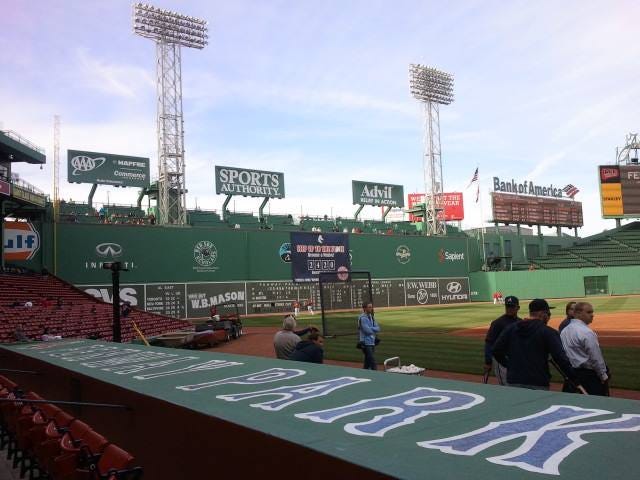
Fenway Park
Wrigley Field
Dodger Stadium
Best Pressbox Food
Citizens Bank Park
CitiField
Yankee Stadium
Best Broadcaster
Pete Van Wieren
Milo Hamilton
Ernie Harwell
Worst Broadcaster
Harold Reynolds
Tim McCarver
Curt Gowdy
Best Publicist
Larry Chiasson
Bob Ibach
Bob Hope
Best Interview (Player)
Steve Garvey
Cal Ripken, Jr.
Dale Murphy
Worst Interview (Player)
Steve Carlton
Amos Otis
Eddie Murray
Best Interview (Manager)
Bobby Cox
Dusty Baker
Jeff Torborg
Worst Interview (Manager)
Billy Martin
Earl Weaver
Jim Leyland
Best Uniform
Cincinnati Reds
St. Louis Cardinals
Boston Red Sox
Worst Uniform
Houston Astros
New York Mets (city collection)
Washington Nationals
Favorite Writer
Jayson Stark
Marty Appel
Hal Bock
Least Favorite Writer
Jack Lang
Jerry Izenberg
Hal Bodley
HtP weekend editor Dan Schlossberg of Fair Lawn, NJ began covering baseball even before earning a journalism degree from Syracuse in 1969. He covers baseball for forbes.com, Memories & Dreams, USA TODAY Sports Weekly, Sports Collectors Digest, and other outlets. His email is ballauthor@gmail.com.
Timeless Trivia
“The Mets seem somewhat schizophrenic. One minute, they’re patient. The next, they’re throwing out near-record offers.”
— Jon Heyman, The New York Post
Three-time batting champ Luis (Line-Drive) Arraez, a free agent, might just stay put in San Diego, which otherwise needs a first baseman . . .
The Yankees also need more stability at the gateway, where Paul Goldschmidt is aging gracefully but also remains on the free agent market . . .
Ex-Mets infielder Luisangel Acuna now projects as a White Sox outfielder — after his trade to Chicago for Luis Robert, Jr.
Know Your Editors
Here’s the Pitch is published daily except Sundays and holidays. Benjamin Chase [gopherben@gmail.com] handles the Monday issue with Dan Freedman [dfreedman@lionsgate.com] editing Tuesday and Jeff Kallman [easyace1955@outlook.com] at the helm Wednesday and Thursday. Original editor Dan Schlossberg [ballauthor@gmail.com], does the weekend editions on Friday and Saturday. Former editor Elizabeth Muratore [nymfan97@gmail.com] is now co-director [with Benjamin Chase and Jonathan Becker] of the Internet Baseball Writers Association of America, which publishes this newsletter and the annual ACTA book of the same name. Readers are encouraged to contribute comments, articles, and letters to the editor. HtP reserves the right to edit for brevity, clarity, and good taste.
Great stuff here. That House Divided review is super interesting bc it reframes Tener's role in organizing that first congressional game. The connection betwen tariff politics and using baseball to ease tensions feels pretty relevant today honestly. Also loved Schlossberg's takes on worst broadcasters, Harold Reynolds definitely belongs onthat list.