
Was Rizzuto The Difference Maker in Yanks-Sox?
PLUS: CANADIAN COLLECTOR LOVED GETTING CELEBRITY SIGNATURES

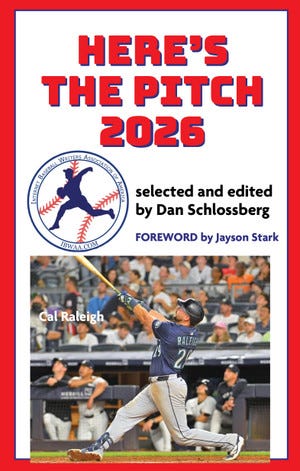
THE FIRST 2026 BASEBALL BOOK — CLICK HERE TO ORDER:
https://actapublications.com/here-s-the-pitch-2026
Pregame Pepper
David Stearns, president of baseball operations for the Mets, hopes a reunion with closer Devin Williams, the latest free agent pilfered from the crosstown Yankees, gives his team protection in the late innings . . .
Williams will either replace Edwin Diaz, who held the closer’s job in Flushing since 2019, or serve as his set-up man if the Mets manage to keep him during the current free-agent season . . .
Stearns was GM of the Milwaukee Brewers when Williams was that team’s lights-out closer . . .
The image of invincibility vanished when Pete Alonso, another Met exploring free agency, hit a ninth-inning home run that sent New York deeper into October . . .
New York’s next target could be Byron Buxton, an Atlanta native also coveted by the Braves but previously unwilling to waive the no-trade clause in his Twins contract . . .
With Ronald Acuña, Jr. and other U.S. stars playing in the Venezuelan Winter League, the iffy political situation could preclude an early or safe return to the United States.
Leading Off
A New Statistic: TED WAR
By Paul Semendinger
A few notes. This article is a follow-up to some comments I received regarding my comparisons of Pee Wee Reese and Phil Rizzuto a few weeks ago.
As I noted in the article, and numerous people made reference to, Ted Williams made a now-famous quote that was used to help Phil Rizzuto gain entry into the Baseball Hall of Fame. According to the National Baseball Hall of Fame web site, the story goes as follows:
“Phil Rizzuto was such an integral part of the New York Yankees’ success in the 1940s and 1950s – when the team won 10 American League pennants and eight World Series titles during his 13 seasons with the club – that fellow Hall of Famer Ted Williams once remarked: “If the Red Sox would have had Phil, we would have won all those pennants.”
It’s a great story.
It’s also not accurate. Not nearly. At all.
In order to make this point, I created a brand new statistic called TED WAR.
TED WAR (a tounge-in-cheek statistic) measures the total games ahead of the Red Sox that the Yankees finished and awards that total to Phil Rizzuto as the difference maker between the two teams.
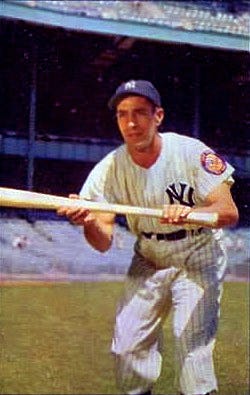
Let’s take a look:
1941 - The Yankees finished in first place. The Red Sox finished in second. Was Phil Rizzuto the difference in the two teams?
Rizzuto was very good in 1941 playing in 133 games and batting .307. He finished 20th in MVP voting. It was a great start for the Scooter. Maybe he was the difference.
But the Red Sox in 1941 has a quality shortstop of their own in Joe Cronin (also a Hall of Famer). Cronin hit .311 and was 11th in the MVP voting. Cronin also edged out Rizzuto in bWAR 4.8 to 4.6.
Also, while the Red Sox were the second place team, they finished 17 games out of first place. It seems unlikely that Phil Rizzuto was the difference between the Yankees and the Red Sox winning the pennant, especially when one considers that Joe Cronin has such a good year himself.
Still, for the sake of this exercise, if Ted Williams is correct, Phil Rizzuto earned 17 TED WAR (the difference in games between the Yankees and the Red Sox) in 1941 alone.
1942 - The Yankees finished in first place. The Red Sox finished second, nine games out.
In 1942, Rizzuto had a nice year, batting .284, earning an All-Star nod, and finishing 19th in MVP voting. Joe Cronin was a part-time player at this point. His best years were behind him. Rizzuto was clearly the better player, but...
Joe Cronin was a part-time player because the Red Sox had a new great shortstop of their own in 1942 who hit .331 and led the A.L. in hits with 205. This player was Johnny Pesky who was worth 6.2 bWAR, bettering Rizzuto’s 5.8. To boot, Pesky finished 3rd in the MVP voting. The Red Sox shortstop had the better season again.
But, if he was the difference, we will grant Phil Rizzuto 9 more TED WAR points. (He has now accumulated 26 in total.)
Phil Rizzuto then missed the 1943, 1944, and 1945 seasons serving in World War II.
1946 - We can cover this season quickly. Phil Rizzuto was not the difference between the Yankees and the Red Sox because the Red Sox won the pennant. The Yankees finished in third place, 17 games out. Rizzuto could not have earned any TED WAR since the Red Sox finished ahead of the Yankees.
1947 - The Yankees finished in first place. The Red Sox finished in third place, 14 games out.
Rizzuto earns another 14 TED WAR.
Of note, both Johnny Pesky and Phil Rizzuto were worth 4.6 bWAR in 1947. Pesky again led the league in hits. He finished 18th in MVP voting. Rizzuto did not earn any MVP votes.
Quick Aside - Did Johnny Pesky ever react to Ted Williams’ assertion that Rizzuto was the difference in the two teams? Pesky was a pretty good player himself. He matches up well to Phil Rizzuto.
1948 - The Red Sox finished in second place, the Yankees in third. Phil Rizzuto could not have been the difference in the Yankees winning because they didn’t win.
1949 - This was the year of the great pennant race between the Yankees and the Red Sox. The Yankees finished in first place, the Red Sox in second, just one game out. This is the first season where Phil Rizzuto could have been the difference maker.
In 1949, Johnny Pesky was worth 4.1 bWAR, Rizzuto 3.0, but Pesky was now a third baseman. Rizzuto had to compete against a different shortstop - Vern Stephens. In 1949, Stevens hit 39 homers and led the league in runs batted in with 159. Stevens was worth 6.9 bWAR, more than doubling Rizzuto’s total.
At the time though, Rizzuto was considered more of a difference maker. He was the runner-up in the MVP voting. Stevens only finished in 7th place.
Phil Rizzuto earned only 1.0 TED WAR for the 1949 season.
1950 - The Yankees won the pennant, the Red Sox finished in third place four games out.
In 1950, Phil Rizzuto had his greatest season batting .324. He led the league with 6.8 bWAR and earned the MVP.
Vern Stephens, though, was no slouch. He earned 3.7 bWAR while again leading the league with 144 runs batted in.
We will award Phil Rizzuto four more points of TED WAR.
1951 - The Red Sox finished in third place, 11 games behind the Yankees.
It seems a stretch to state that Rizzuto was the difference. Of note, Johnny Pesky was back at shortstop for the Sox and he did quite well. Pesky bettered Rizzuto in bWAR 4.4 to 3.6.
Again, it seems that while Rizzuto was a very good player, one deserving of many accolades, he wasn’t appreciably better than the players the Red Sox had at shortstop in any season.
Rizzuto though earns 11 more TED WAR increasing his career total to 56.
1952 - The Red Sox finished in 6th place, 19 games out.
There is no way Rizzuto was the difference between the two teams, although he was vastly superior to the Red Sox shortstop Johnny Lipon who batted only .205. In 1952, Rizzuto was again an All-Star.
For this season, Rizzuto earns 19 more TED WAR increasing his career total to 75.
1953 - The Red Sox finished in fourth place, 16 games out.
Rizzuto earns 16 more TED WAR rasing his total to 91.
1954 - The Yankees did not win the pennant in 1954. Neither did the Red Sox. 1954 was the Cleveland Indians’ year.
1955 - By 1955, Phil Rizzuto was a part-time player. His final season was 1956.
Conclusion - A few facts seem very clear:
Phil Rizzuto was a great shortstop in his era. He contributed greatly to the Yankees’ success.
The Red Sox also had fine shortstops in that era and in many seasons the Red Sox shortstop had better numbers statistically than Rizzuto.
Ted Williams seems to have discounted the great work of his teammates while inflating Rizzuto’s impact.
Ted Williams wasn’t stating facts. He was exaggerating, but his exaggeration helped Phil Rizzuto get into the Hall, so, the quote, in the end, did what it was supposed to do.
The following are the career numbers of Phil Rizzuto, Johnny Pesky, and Vern Stevens:
Phil Rizzuto: 13 seasons, 1,588 hits .273/38/563 42.1 WAR
Johnny Pesky: 10 seasons, 1,277 hits .307/17/404 34.1 WAR
Vern Stevens: 15 seasons, 1,859 hits .286/247/1,174 46.4 WAR
Paul Semendinger has written numerous award-winning books. West Point at Gettysburg, which will be released by Sunbury Press shortly, is receiving a great deal of early praise. Paul is a retired principal, a college professor, an author, a dad, and a grandpa. His best title is grandpa.
Cleaning Up
Non-baseball celebrities intrigued musician-collector Geddy Lee
By Dan Schlossberg
Baseball fans come in all sizes, sexes, shapes, and nationalities. Some of them actually achieve celebrity in other fields.
That’s certainly the case for Gary Lee Weinrib, a 72-year-old Toronto native whose immigrant parents were Holocaust survivors.
He’s better known as Geddy Lee of the rock band Rush, formed in 1968 but popularized after Lee added his talents as vocalist and bass player.
Lee later became enamored with baseball memorabilia — especially after meeting a myriad of Hall of Famers from both the baseball and music worlds.
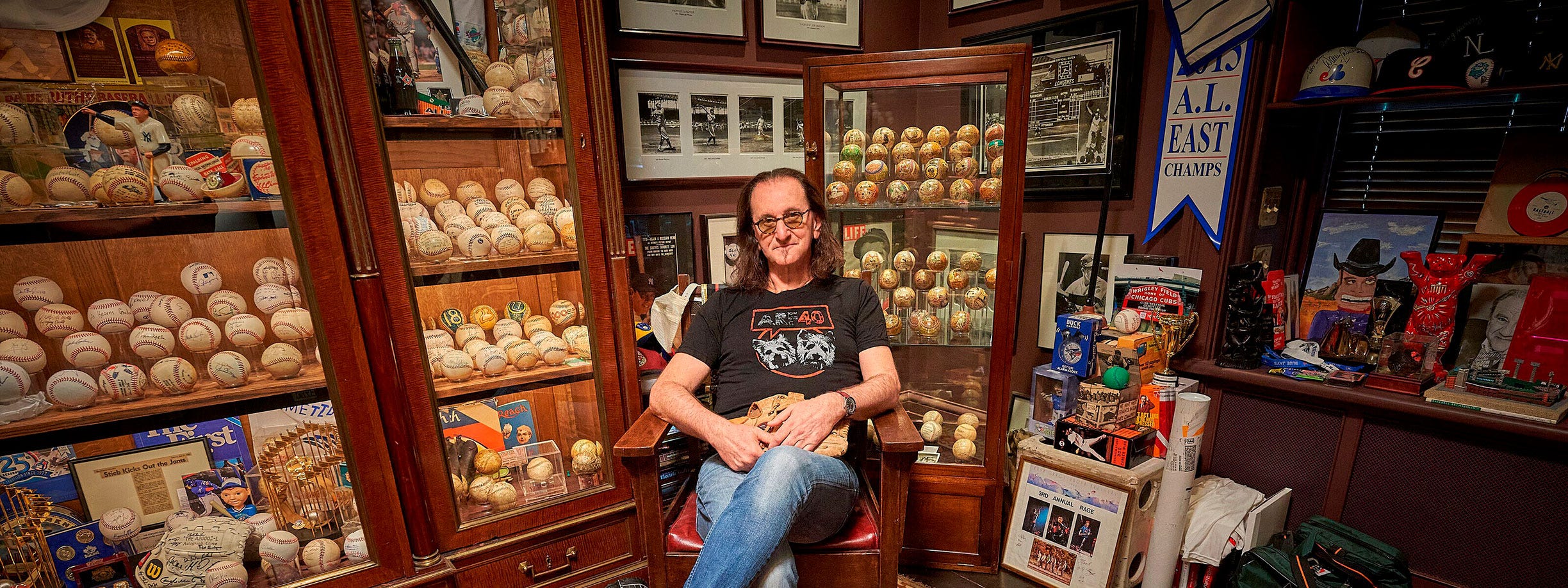
A fan of the late, great Montreal Expos who had no trouble switching his allegiance to the Toronto Blue Jays, Lee became an autograph hound, collecting and keeping shelves of balls signed by everyone from Babe Ruth to Paul McCartney.
Those balls — and the stories that accompany them — fill the pages of 72 Stories From the Baseball Collection of Geddy Lee (Harper, 2025).
Perhaps more than any hardcover published this year, it is guaranteed to entertain and educate for those countless hours when true fans pine for the first sign of spring.
It is certainly the only book in a long time — and that includes mine — with separate chapters for JFK, Fidel Castro, Neil Armstrong, and Shohei Ohtani. There’s even a section that could have been called “Oddball Baseballs,” with a picture of a Mickey Mantle signed ball that reads, “He was safe, asshole.”
Lee’s collection includes baseballs from Moe Berg, the invisible star of the 1934 post-season tour of Japan, and Eddie Gaedel, the midget who made the most of a one-at-bat career. There’s even one signed by both Bill Clinton and Monica Lewinsky, with the author wondering who signed first.
“I love it when someone with a completely abstract connection to the game lands on a baseball,” Lee wrote. “It’s great when you find an important figure in American history who becomes a part of baseball culture, if only they signed a baseball that lives on my shelf.”
As he approached age 70, Lee decided to sell a chunk of his collection through a Christie’s auction, raising $6.9 million in the process.
Items included famous Babe Ruth and Hank Aaron jerseys and a Gehrig bat.
According to the music legend, Gehrig, Frank Sinatra, and Armstrong were reluctant signers — making baseballs with their signatures even more valuable.
Eighty million baseball fans heard Lee sing the Canadian National Anthem at the 1993 All-Star Game (with James Earl Jones singing The Star Spangled Banner) but the highlight of the event for Lee was making more contacts and acquiring more memorabilia.
“I sang the slowest version of the Canadian anthem ever performed in public,” wrote Lee, who said he was highly nervous, especially when told how many people were watching. He has done it again many times, either in Toronto or in U.S.-based games the Jays were playing.
The last line in the musician’s book is worth remembering: “To my wonderful children for not complaining while watching Dad spend their inheritance on baseballs.”
This columnist can relate.
Happy Chanukah and Merry Christmas to all those who are equally smitten.
HtP weekend editor Dan Schlossberg of Fair Lawn, NJ covers baseball for forbes.com, Memories & Dreams, USA TODAY Sports Weekly, Sports Collectors Digest, and other outlets. His email is ballauthor@gmail.com.
Timeless Trivia: More Money Talk
Cleveland fans shouldn’t hold out much hope for the return of pitchers Emmanuel Clase and Luis Ortiz, both on administrative leave because of alleged involvement in illegal gambling activities . . .
How big a deal is sports betting? ESPN reports that in 2023, people wagered $150 million and lost $13 billion.
Their court cases have been scheduled for May, well into the start of the ‘26 season . . .
Official attendance for that Braves-Reds game at the Bristol Motor Speedway last August was 91,032 — a record for an official game but not for World Series play, since several games drew 93,000 plus to the Los Angeles Coliseum for White Sox-Dodgers games in 1959 . . .
Seattle center-fielder Julio Rodriguez is the only player to produce 20/20 seasons in each of his first four years in the majors . . .
A signed Yoshinobu Yamamoto card brought $72,000 at auction for Karl-Anthony Towns, power forward of the New York Knicks and a former pitcher himself (in high school) . . .
Towns, a 30-year-old North Jersey native, was willing to sell the Yamamoto card because he’s mainly interested in adding to his extensive collection of Yankees.
Know Your Editors
Here’s the Pitch is published daily except Sundays and holidays. Benjamin Chase [gopherben@gmail.com] handles the Monday issue with Dan Freedman [dfreedman@lionsgate.com] editing Tuesday and Jeff Kallman [easyace1955@outlook.com] at the helm Wednesday and Thursday. Original editor Dan Schlossberg [ballauthor@gmail.com], does the weekend editions on Friday and Saturday. Former editor Elizabeth Muratore [nymfan97@gmail.com] is now co-director [with Benjamin Chase and Jonathan Becker] of the Internet Baseball Writers Association of America, which publishes this newsletter and the annual ACTA book of the same name. Readers are encouraged to contribute comments, articles, and letters to the editor. HtP reserves the right to edit for brevity, clarity, and good taste.