
Do Catchers on MVP Ballot Merit Extra Credit?
PLUS: HOW DAN SCHLOSSBERG WOULD VOTE FOR HALL CLASS OF 2026

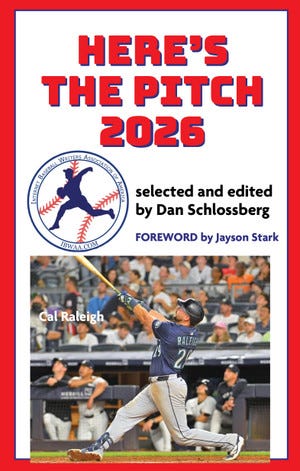
THE FIRST 2026 BASEBALL BOOK — CLICK HERE TO ORDER:
https://actapublications.com/here-s-the-pitch-2026
Pregame Pepper
Good news & bad news: the 2026 Baseball Winter Meetings are scheduled for San Diego but likely to be cancelled by an owners’ lockout that will plunge the game into a nuclear winter (no trades, no signings, no negotiations) . . .
Since his new Dodgers contract contains a club option for 2029, count on Edwin Diaz closing games for L.A. through the end of the decade . . .
The signing of Jorge Polanco gives the Mets five potential second basemen: Marcus Semien, Jeff McNeil, Luisangel Acuna, Brett Baty, and Polanco . . .
Even though Robert Suarez led the NL with 40 saves, he’s slated to work as a set-up man for Raisel Iglesias in Atlanta’s 2026 bullpen . . .
Buck Showalter, who managed both the Orioles and the Mets, believes Pete Alonso will have a prolific season playing half his schedule in hitter-friendly Oriole Park . . .
Walt Weiss can’t decide whether Ronald Acuna, Jr. should bat first or third but leans toward the leadoff spot. “It would be nice to have him up there whenever the lineup turns around,” said the new Atlanta manager . . .
Although Jack and Joe Buck are the first father-and-son tandem to take the Ford C. Frick Award for excellence in baseball broadcasting, the late Milo Hamilton — the Frick winner in 1992 — believed “national” voices who worked once a week or less should not be considered for the honor.
Leading Off
MVP EXTRA CREDIT (Catchers: Part 1)
By Paul Semendinger
I have been researching MVP voting over the years and have come to the conclusion that catchers receive extra credit.
It seems that when catchers have good to great years, they receive a great deal of consideration for the MVP Award. This is especially true if the catcher is on a pennant-winning team — even if he had a teammate who had a superior statistical season.
The trend to award catchers “extra-credit” has occurred almost as long as the MVP has been awarded. This article will examine catchers and the MVP Award from 1931 through 1969. I will use Baseball-Reference WAR retroactively as a standard measure (in addition to other statistics) while understanding and recognizing that WAR was not a statistic at the time.
1934
The first catcher to win an MVP was Mickey Cochrane in 1934. (The MVP Award, as we know it, was first given in 1931.)
In 1934, Cochrane batted .320. Not bad! But, he hit only two home runs while driving home 75 runs. In 1934, Cochrane earned only 4.5 WAR which placed him 12th among the vote getters.
The MVP in 1934 should have been Lou Gehrig who batted .363/49/166 winning the Triple Crown as he earned 10.0 WAR.
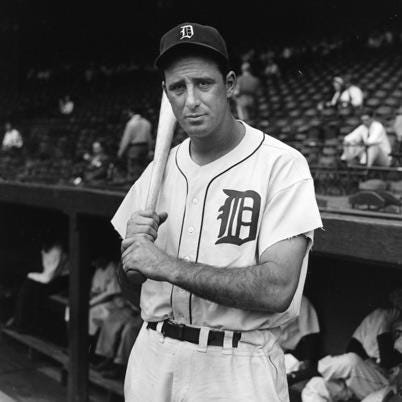
In 1934, though, it was the Tigers’ year. They won the American League pennant. The runner-up in MVP voting was their second baseman Charlie Gehringer. Pitcher Schoolboy Rowe finished fourth in the voting. First baseman Hank Greenberg finished sixth. Gehrig, in spite of his great season, finished fifth. It seemed that winning the pennant was what mattered in 1934, and even though Gehringer, Rowe, and Greenberg all had better years (by WAR) than Cochrane, the winner of the MVP was the leader on the field in the eyes of the writers, the catcher.
1935
The very next year, Gabby Harnett, a catcher, won the N.L. MVP while helping to lead the Chicago Cubs to the pennant. Hartnett hit .344/13/91, but only totaled 4.9 WAR placing 14th among vote getters. The MVP should have been Arky Vaughn of the Pittsburg Pirates who totaled 9.8 WAR while leading the league in batting as he accumulated a batting line of .385/19/99.
Of note, Billy Herman and Augie Galan, both of the Cubs also finished in the top ten vote-getters. They both had higher WARs than Hartnett.
1938
Catcher Ernie Lombardi batted .342/19/95 for the Cincinnati Reds and won the N.L. MVP. Lombardi did lead the league in batting. The Reds, though, finished in only fourth place, and Lombardi earned only 4.8 WAR, ninth best among vote getters.
Both Arky Vaughn and Mel Ott earned 8.9 WAR in 1938, but the winner of the award was a catcher.
1951
It took 13 years for a catcher to win the MVP again, but once they awarded an MVP to one, they gave it to two. In 1951, Yogi Berra won the MVP in the American League while Roy Campanella won the award in the National League.
In 1951, Berra batted .294/27/88 (5.3 WAR). Campanella hit .325/33/108 (6.9 WAR). The Yankees won the A.L. pennant, the Dodgers lost out in the famous playoff to the New York Giants.
Berra was 6th in WAR in the A.L. Ted Williams led the league with 7.1 WAR.
Campanella was also 6th in WAR. His teammate, Jackie Robinson led the league with 9.7 WAR.
1953
Roy Campanella won his second MVP Award, but was 8th in WAR behind teammates Duke Snider and Jackie Robinson. Pitcher Robin Robers led the National League with 9.9 WAR. Duke Snider had 9.1 WAR to lead all position players. Neither Roberts nor Snider, though, was a catcher.
1954
Yogi Berra won his second MVP in one of the few seasons of the 1950s when the Yankees did not win the pennant. Berra batted .307/22/125 and earned 5.3 WAR. The best player in the league Minnie Minoso who earned 8.1 WAR. Berra was only 8th among the players earning votes in WAR.
1955
In the season when the Brooklyn Dodgers won their only World Series over the Yankees, Yogi Berra and Roy Campanella both won their third MVP awards.
Berra’s 4.5 WAR was 11th in the league. Mickey Mantle earned 9.5 WAR.
Campanella’s 5.2 WAR was 12th in the league. Willie Mays earned 9.2 WAR. Duke Snider of the Dodgers was the runner-up in WAR at 8.6.
1963
As the Yankees dynasty was drawing to a close, Elston Howard batted .287/28/85 — good enough for 5.2 WAR, placing him 7th among vote-getters. Bob Allison of the Minnesota Twins earned 7.4 WAR.
1970
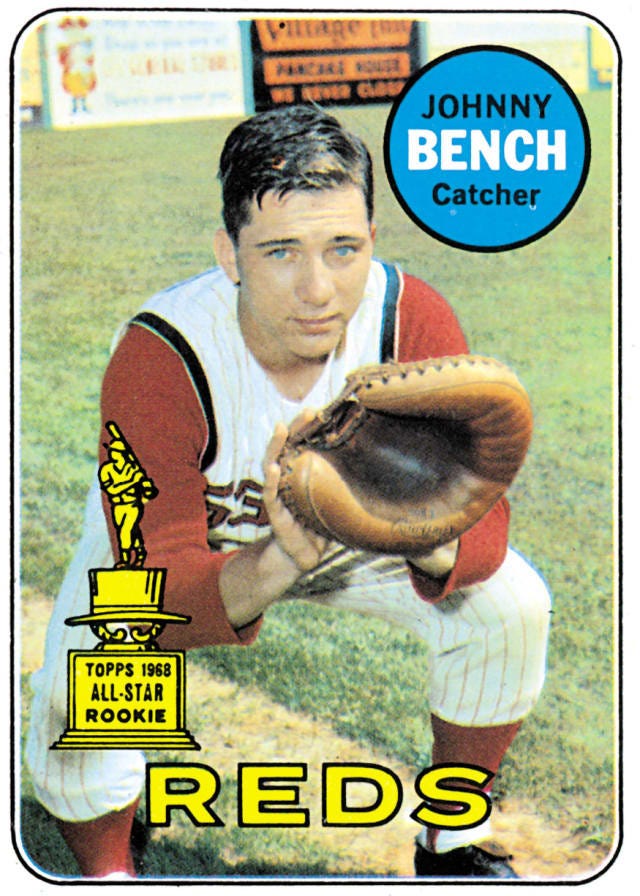
Johnny Bench won the N.L. MVP while batting .293/45/148. Bench’s 7.4 WAR was impressive. He also led the league in home runs and RBIs. Bench led all position players in WAR as his Cincinnati Reds won the pennant.
This was the first time since the award started in 1931 that a catcher was the best position player statistically. Johnny Bench was the rightful winner of the 1970 MVP.
No other catcher had had a season quite like Bench’s. He is the only catcher in the first 50 years of the MVP to lead position players in WAR.
1972
Bench batted .270/40/125, leading the league in homers and runs batted in while putting up 8.6 WAR as he won his second MVP Award. His teammate, Joe Morgan, .292/16/73, who also lead the league in walks, runs, on base percentage, and had 58 stolen bases had a higher WAR (9.3), but awarding this to Bench, again, makes a lot of sense.
1976
Thurman Munson earned the A.L. MVP after batting .302/17/105. He earned 5.3 WAR. Graig Nettles, a teammate of Munson’s, led all position players in WAR with 8.0, but, Munson, who was 12th in WAR among vote-getters, but a catcher on a pennant- winning team, won the award.
1931-1979 Summary
In this 49-year period, only one catcher, Johnny Bench in 1970, led position players in WAR. That season, he rightfully won the MVP. But, in this time 13 catchers won their league’s Most Valuable Player Award.
The trend was set. When a catcher has a very good to great year, it is clear that the MVP voters award him extra credit. This is especially true when a catcher has a good to great year and his team wins the pennant.
It seems very clear that when it camer to MVP voting, if measured by WAR, at least in the first 49 years of the award, that there were catchers who earned extra credit from the voters.
Part Two of this series will examine the seasons from 1980 through 2025.
Dr. Paul Semendinger’s newest book, West Point at Gettysburg (Part 1), is earning outstanding reviews. An award-winning author, Paul is looking forward to Christmas when he will be able to enjoy lots of time with his family.
Cleaning Up
Jones + Beltran Head Hall’s Class of 2026
By Dan Schlossberg
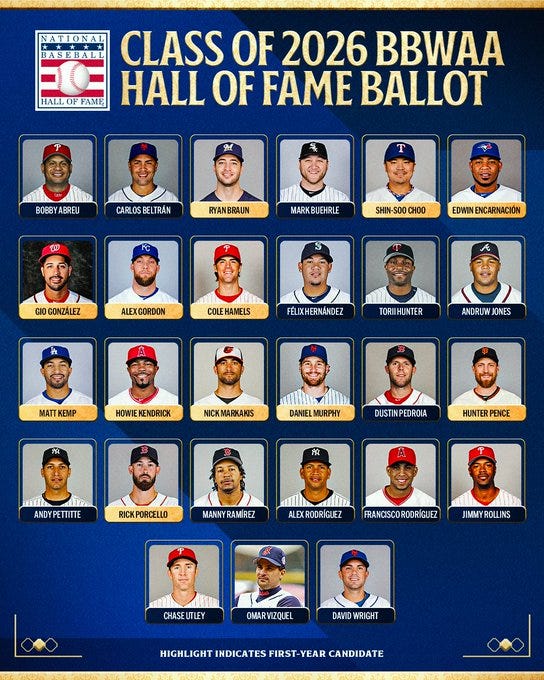
Since this is the last weekend edition of Here’s the Pitch before votes are due for Cooperstown’s Class of 2026, it’s time to talk turkey — though Thanksgiving is long past.
Even without any strong first-year candidate this winter, there’s enough meat on the ballot left over from previous seasons.
The most deserving candidates are last year’s top two finishers, Carlos Beltran and Andruw Jones.
But that doesn’t mean voting members of the Baseball Writers Association of America should omit the other eight spaces on their ballots.
In fact, writers who fail to fill out their ballots completely — and that means with 10 names — skew the process and thus make it more difficult for anyone to garner the required 75 per cent for election.
Listing 10 players only indicates election preference. A ballot containing one or two names — or returned blank — pushes that three-quarters threshold further away.
Nine different times, most recently in 2021, nobody drew 75 per cent of the vote. And sometimes even the magic of a big name isn’t enough. In 1971, Yogi Berra had the top percentage. But it was only 67 per cent.
Last January, the writers picked Ichiro, Billy Wagner, and CC Sabathia, with Beltrán (70.3 per cent) and Jones (66.2 per cent) having to wait. Now they’re head and shoulders above the rest of the class.
Jones should be elected on his defensive prowess alone. He’s one of five outfielders with 10 straight Gold Gloves, along with Willie Mays, Roberto Clemente, Ken Griffey, Jr., and Ichiro — all of whom are already enshrined.
Plus he had 434 home runs, most of them for the Atlanta Braves.
Jones is best remembered as the youngest man to homer in a World Series and only the second, after Gene Tenace, to connect in each of his first two at-bats.
Although he didn’t arrive until late in 1995, the man from Curacao had a higher WAR than any of his teammates during the 14-year title run of the Braves. That group includes Chipper Jones and the terrific pitching troika of Greg Maddux, Tom Glavine, and John Smoltz. All are already in Cooperstown, along with manager Bobby Cox.
Late-career struggles by Jones should not be held against him. Plenty of people already in the Hall of Fame gallery had similar regressions. Think Willie Mays, Mickey Mantle, Duke Snider, Warren Spahn, and countless other luminaries.
Like Jones, Beltrán brought power plus defense to his game. A nine-time All-Star, the fleet Puerto Rican hit 435 home runs while dividing his time among seven teams. The former Rookie of the Year had a .279 career average — 25 points above Andruw’s final mark — but only three Gold Gloves. Plus he was widely considered the ringleader of the illegal electronic sign-stealing scheme of the Astros during the 2017 World Series.
What about those other eight spots? In order of preference, I would list Andy Pettitte, Chase Utley, Jimmy Rollins, Cole Hamels, Mark Buerhle, David Wright, and Dustin Pedroia — while definitely avoiding Alex Rodriguez, who still reeks from the stench of steroids, and Manny Ramirez, whom I also believe indulged in performance-enhancing substances.
Utley and Rollins were heavy-hitting middle infielders for Philadelphia, which also got the best of Hamels when the southpaw was pitching there. Both Rollins and Pedroia even managed to win MVP awards against long odds.
The feats of A-Rod, Ramirez, Mark McGwire, and Sammy Sosa — not to mention Barry Bonds and Roger Clemens — are already covered in the museum half of the Cooperstown institution and don’t demand a wall plaque in the Hall portion.
It’s not like they didn’t exist but just that they don’t deserve a hallowed place of honor or to share space with Hank Aaron, Sandy Koufax, and Cal Ripken, Jr. Same deal for Pete Rose, who led baseball in both hits and lies. Though taken off the permanently ineligible list, he might not even make the ballot when the Classic Era Committee votes for the Class of 2028.
The key to election is getting voters to fill out their ballots in order of preference. Anything less is a disservice to those who truly deserve enshrinement.
HtP weekend editor Dan Schlossberg of Fair Lawn, NJ covers baseball for forbes.com, USA TODAY Sports Weekly, Memories & Dreams, Sports Collectors Digest, and a myriad of other outlets. He’s now booking talks, power points, and baseball-related appearances for 2026 via email ballauthor@gmail.com.
Timeless Trivia: Cutting Up World Series Cash Pie
Players of the Los Angeles Dodgers, owners of baseball’s biggest payroll, got a bonus for winning their second straight World Series in 2025 . . .
According to the Associated Press, the Dodgers divided a pool of $46.1 million into 82 full shares and 12 1/2 partial shares for 94.5 full-share equivalents. A full share went for $484,748, an increase over 2024 but down from the records of 2022 and 2023 . . .
Houston players earned $516,347 in 2022, while Texas Rangers players got $506,263 a year later . . .
Players, coaches, and managers with the team or on the injured list after June 1 or later got a full share but those not with the team on that date may receive either a full share or a percentage decided by vote of the team’s players . . .
Two certified athletic coaches and one strength and conditioning coach also got shares . . .
Spring training coaches, scouts, and grounds crew members not eligible for shares but can get cash grants, though executives, doctors, and security people are ineligible . . .
Players on the Toronto Blue Jays, beaten by the Dodgers in the seven-game Fall Classic, got full shares of $354,119 . . .
The Jays had 70 full shares, 15.44 partial shares, and various cash awards . . .
The total post-season pool of $128.2 million was down from the $129.1 million of last year, when it reached an all-time high. The annual pool is determined by ballpark size.
Know Your Editors
Here’s the Pitch is published daily except Sundays and holidays. Benjamin Chase [gopherben@gmail.com] handles the Monday issue with Dan Freedman [dfreedman@lionsgate.com] editing Tuesday and Jeff Kallman [easyace1955@outlook.com] at the helm Wednesday and Thursday. Original editor Dan Schlossberg [ballauthor@gmail.com], does the weekend editions on Friday and Saturday. Former editor Elizabeth Muratore [nymfan97@gmail.com] is now co-director [with Benjamin Chase and Jonathan Becker] of the Internet Baseball Writers Association of America, which publishes this newsletter and the annual ACTA book of the same name. Readers are encouraged to contribute comments, articles, and letters to the editor. HtP reserves the right to edit for brevity, clarity, and good taste.