
Loving Strat-o-Matic Baseball
PLUS: SEPARATING SUSPECTS FROM PROSPECTS

Pregame Pepper
The Red Sox and Braves both started this weekend with eight-game winning streaks . .
Only two years ago, Marcell Ozuna had 39 home runs and a career-best 104 RBIs for Atlanta but has fallen fast at age 35, earning a release by the Pirates Wednesday . . .
Cleveland has now traded both Naylor brothers, Bo [Brewers] and Josh [Mariners] . . .
Another Naylor brother, Myles, got a $2 million bonus to sign with the Athletics and is now a third baseman in their system . . .
George Lombard, Sr. wasn’t much of a hitter but both of his sons staged heroics in their debuts Tuesday: George Jr., who bats left-handed, homering in his second at-bat for the Yankees and just-drafted younger brother Jacob, right-handed all the way, homering in his second at-bat for Jupiter, a Marlins farm team . . .
Both young shortstops feasted on breaking balls, which they pulled to left field with launch angles of 33 degrees and comparable exit velocities (100.2 mph for George, Jr. and 99.9 for Jacob) . . .
When their teams couldn’t unload them at the trade deadline, five notable veterans lost their varsity spots anyway: relief pitchers Craig Kimbrel (Rays) and Matt Strahm (Royals), catcher Mitch Garver (Mariners), and designated hitters Jorge Soler (Angels) and Marcell Ozuna (Pirates) . . .
Matt Olson has a chance to break his own Braves franchise record for home runs — he hit 54 in 2023, when he led both leagues in home runs and runs batted in.
Leading Off
What Strat-o-Matic Had To Say About Jeter’s Defense
By Paul Semendinger
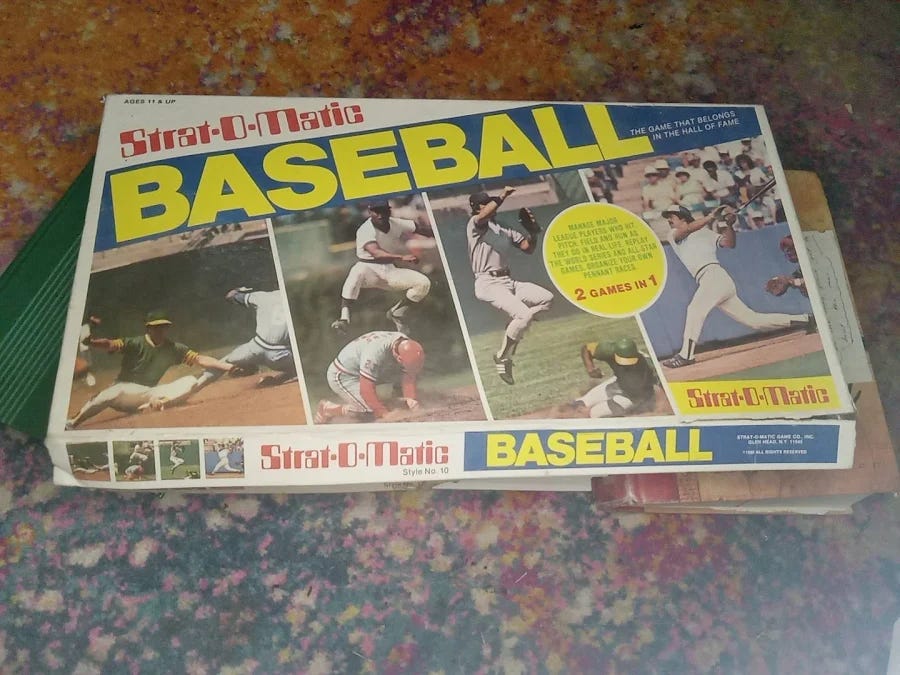
One of the best Christmas presents I ever received came in 1981 when my grandmother gave me the Strat-o-Matic Baseball board game. From that point forward, on and off, I have played Strat-o-Matic. It is my favorite board game of all time. When I need to relax, Strat-o-Matic is always there for me.
I sometimes like to look back at baseball history by looking at Strat-o-Matic cards. One can see Babe Ruth in his prime as well as his decline years by looking and comparing his Strat cards from, for example, 1927 and 1934. One can compare Ichiro Suzuki’s greatest seasons with those of Ty Cobb or Tris Speaker. The game allows fans to understand baseball history and baseball strategy on a deep level.
As a Yankees fan, I remember all the hype about Derek Jeter’s fielding. Some said he was elite. Others said he was over-rated.
As I pondered this question recently, I wondered what my Strat cards said about Jeter’s defense.
The following are Derek Jeter’s Fielding Ratings at shortstop for his career:
(A quick note, as a shortstop, the best fielding rating a player can get is a 1. The best players, the ones with the most range, earn a 1. The worse fielders are a 4 or a 5.)
1995: ss-4
1996-97: ss-2
1998-2000: ss-1
2001-02: ss-2
2003: ss-3
2004-05: ss-2
2006: ss-1
2007-09: ss-2
2010-12: ss-3
2013-14: ss-4
Strat-o-Matic has a formula (I assume it is a secret formula) to determine the ratings for the players. To me, the numbers seem to reflect Jeter’s career. When he was at his best, he covered a lot of ground. He was a top shortstop. During the years of the Yankees three consecutive World Championships, he was a 1 (which, if you play the game) is very necessary in order to win against the best teams.
Still, as Jeter’s career progressed, some baseball fans and experts noted his defensive shortcomings. Strat-o-Matic seemed to have that covered as well. As his career progressed, his field ratings got worse.
Board games are not real life, of course, but, in this Strat-o-Matic seems to have done an excellent job reflecting Derek Jeter’s defensive prowess across his career.
Paul Semendinger is award-winning author. His novel, Scattering the Ashes, is available as an audio book and is featured on Spotify.
Cleaning Up
Swapping Veterans for Prospects is Always a Gamble
By Dan Schlossberg
All prospects are suspects until proven otherwise.
It doesn’t matter how much bonus money they made or how they did in the minor leagues.
All that counts is major-league performance.
That’s why trading proven players for prospects is a gamble bigger than anything Pete Rose ever pulled.
When the smoke cleared after the Aug. 3 baseball trade deadline, 83 prospects had been traded, with more than 50 of them landing on their new team’s Top 30 prospects list.
Five prospects from Minor League Baseball’s Top 100 list also found new teams. That hadn’t happened since 2022.
It may be years before we have a better idea of which teams made out like bandits and which ones got fleeced.
According to the Minor League Pipeline, the New York Mets acquired both quality and quantity, not only landing 11 prospects but placing eight of them on their Top 30 list. Though last in the National League East they had been predicted to dominate, the Mets now have four new players in their Top 15: Jefferson Rojas, Sammy Stafura, Aidan Smith, and Émilien Pitre.
Rojas immediately became New York’s No. 1 prospect.
But the team had to move veteran pitchers Freddy Peralta, Clay Holmes, Luke Weaver, Brooks Raley, Huascar Brazobán, and A.J. Minter plus outfielder Tyrone Taylor in deal involving a trio of contending clubs.
Both Washington and Baltimore added eight prospects each, with the Angels and Marlins acquiring seven and the Giants and Tigers an even half-dozen apiece.
The Orioles engineered a seven-play swap — biggest of any on Deadline Day — with the division rival Boston Red Sox by packaging catchers Adley Rutschmann and Jake Rogers for veteran backstop Carlos Narvaez and four prospects: outfielder Enddy Azocar, and right-handed pitchers Anthony Eyanson and Kyson Witherspoon plus a player to be named later.
Eyanson is now the top Baltimore prospect, making the Orioles the only team besides the Mets to land a new No. 1.
Oddly, the Detroit Tigers did not do as well as expected in dealing away top starters Tarik Skubal and Casey Mize. Several rival teams claimed they offered more prospects, in quality and quantity, than the trio the Bengals obtained from the Los Angeles Dodgers: Zyhir Hope, River Ryan, and Brady Smith.
In fairness, however, three of the new baby Tigers crashed now are among their top half-dozen prospects.
Another AL Central club, the Cleveland Guardians, yielded four prospects for Washington lefty Foster Griffin, a National League All-Star just a month ago.
The Nats placed one of that quartet, Josh Hartle, on their Top 30 list but added three more in Jack Cebert, Ben Grable, and Yovanny Cruz, all acquired from the Yankees in exchange for NL slugging leader Luis Garcia, Jr., a lefty-hitting first baseman.
Like the Nationals, the Marlins secured four new acquisitions for their Top 30 list after trading catcher Liam Hicks to the Rays and pitcher Braxton Garrett to the Cubs.
Many of the veterans traded before deadline are rentals, eligible for free agency this fall. But that hardly mattered to teams in wins-now mode, especially with the playoffs now including a dozen different teams.
The first prospect to produce was George Lombard, Jr., who homered in his first game (and second at-bat) for the Yankees. He could be the answer to the shortstop void created by the retirement of Derek Jeter.
Although Lombard was already in the Yankees farm system, his recall resulted from a reshuffling of the New York infield after the Luis Garcia, Jr. deal.
HtP weekend editor Dan Schlossberg has covered baseball since 1969. He’s worked for The Associated Press, forbes.com, and a myriad of other outlets. Dan’s email is ballauthor@gmail.com.
Extra Innings: Deadline Post Mortem
When the Braves traded for Jorge Soler at the 2021 trade deadline, he was hitting .192 with 13 homers for the Royals — yet became the World Series MVP that year . . .
Before the Dodgers dealt for Tarik Skubal, the only teams that traded for a defending Cy Young Award winner were the 2009 Phillies (Cliff Lee) and 2023 Astros (Justin Verlander) . . .
Skubal was the first player with back-to-back Cy Young trophies traded to the team that had won the last World Series (and certainly not the last two!) . . .
New Philadelphia second baseman Luis Arraez is en route to his fourth batting crown — all with different teams . . .
Before he won the 2024 batting crown, Arraez was traded in mid-season, though he wasn’t leading the league when Miami sent him to San Diego . . .
Players leading the National League in batting (Arraez) and slugging (Luis Garcia, Jr.) were both traded earlier this week . . .
Six American League teams began play Thursday within four games of a wild-card spot but none had a winning record . . .
Casey Mize (2018) and Adley Rutschmann (2019), both traded this week, were once No. 1 picks in the amateur draft.
Know Your Editors
Here’s the Pitch is published daily except Sundays and holidays. Benjamin Chase [gopherben@gmail.com] handles the Monday issue with Dan Freedman [dfreedman@lionsgate.com] editing Tuesday and Jeff Kallman [easyace1955@outlook.com] at the helm Wednesday and Thursday. Original editor Dan Schlossberg [ballauthor@gmail.com], does the weekend editions on Friday and Saturday. Former editor Elizabeth Muratore [nymfan97@gmail.com] is now co-director [with Benjamin Chase and Jonathan Becker] of the Internet Baseball Writers Association of America, which publishes this newsletter and the annual ACTA book of the same name. Readers are encouraged to contribute comments, articles, and letters to the editor. HtP reserves the right to edit for brevity, clarity, and good taste.