
Quintet of Yankees Wore Uniform No. 8
ALSO: THE LATE, GREAT SEATTLE PILOTS WERE ONE-YEAR WONDERS

Pregame Pepper
Entering play Friday, Seattle was hitting .184 as a team, worst in the majors, while their 40 runs are the second-fewest, ahead of only the 39 scored by the Reds . . .
Two months after he enters the Cooperstown gallery, Carlos Beltrán will have his No. 15 retired by the Mets, whose logo he will wear on his bronze plaque . . .
New York Post columnist Phil Mushnick was right on point when he lambasted the Yankees for making fans wait through a rain delay of nearly four hours . . .
Did Bud Selig have the audacity to say inter-league games are “a gift to our fans?” . . .
Wonder whether hand-picked successor Rob Manfred feels the same way about the Manfred Man, the free extra-innings runner intended to shorten regular-season games but not good enough to be deployed in the post-season . . .
Kudos to NBC for resorting to an old but cherished broadcast tradition: using one announcer from the home team, another from the visitors, along with one of its own guys . . .
Tampa Bay reported an Opening Day “sellout” but a crowd of only 25,114 at hurricane-ravaged Tropicana Field.
Leading Off
The Greatest New York Yankee in Uniform #8
By Paul Semendinger
The following is an excerpt from my newest book The Greatest New York YankeesBy Uniform Number (published by Artemesia Publishing):
Only five Yankees wore No. 8.
Four of those were catchers: Johnny Grabowski, Bill Dickey, Aaron Robinson, and Yogi Berra.
The only non-catcher to wear this uniform number as a Yankee was outfielder Johnny Lindell.
Today, uniform No. 8 is retired for both Bill Dickey and Yogi Berra, the two greatest catchers in the history of the Yankees.
Both players are in Monument Park and the Baseball Hall of Fame.
Bill Dickey, who wore uniform No. 10 in 1929, his rookie season, wore No. 8 from 1930 until 1946 the end of his career, played entirely with the Yankees. In 1944 and 1945, Dickey served in the military during World War II.
Over the course of his career, Dickey batted over .300 11 times. He was also an 11-time All-Star. The Yankees went to eight World Series, winning seven of them with Dickey as their starting catcher.
For his career, Bill Dickey batted .313 with 202 home runs and 1,209 runs batted in. His batting average is the fifth highest all-time in Yankees history. Bill Dickey earned 56.4 WAR.
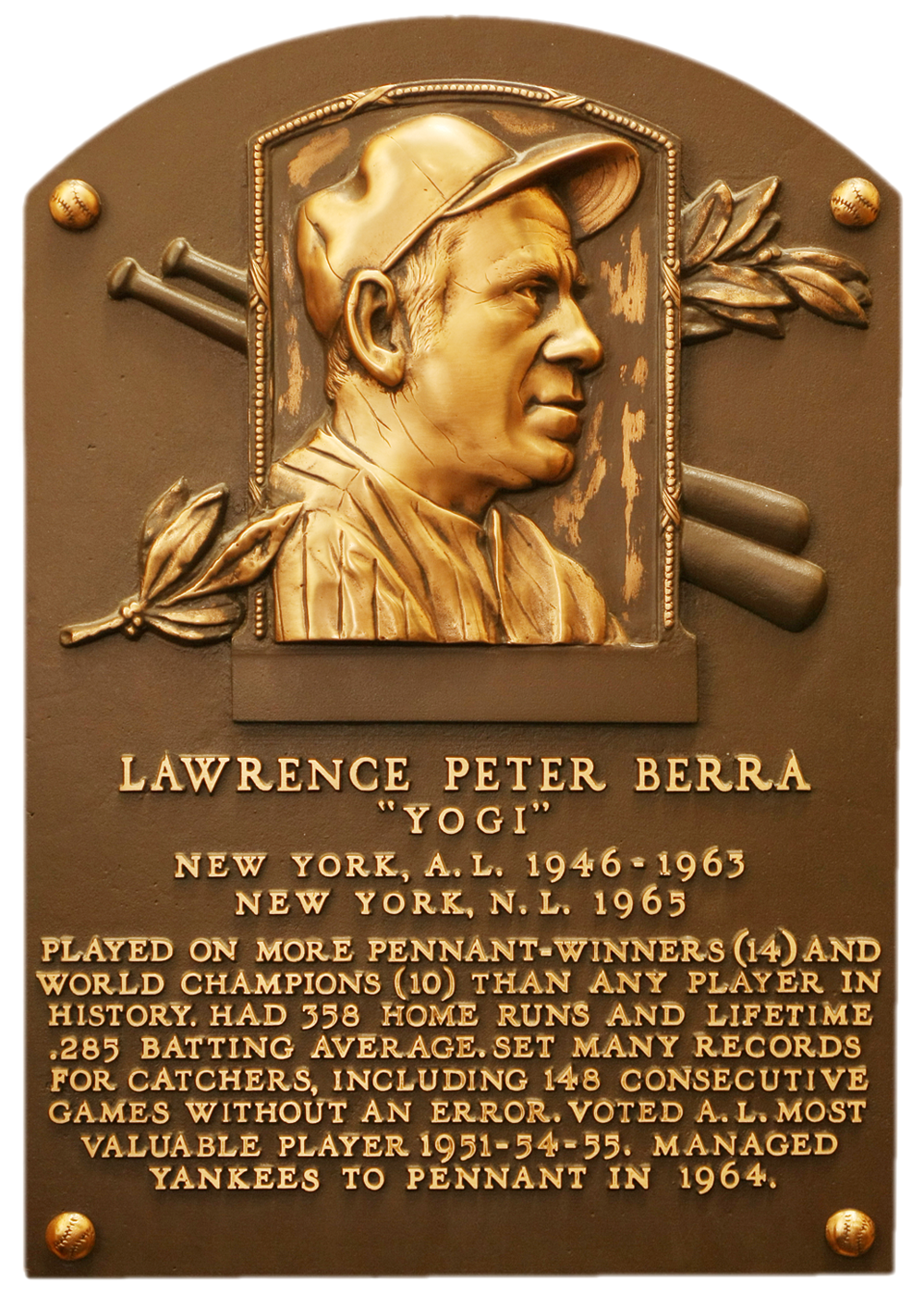
Yogi Berra succeeded Dickey as the Yankees catcher, starring behind the plate from 1946 to 1963. Berra missed the 1944 and 1945 seasons serving in World War II. He wore uniform No. 8 from 1948 until the end of his career after first wearing Nos. 38 and 35.
Berra was an 18-time All-Star, the second highest (only to Mickey Mantle’s 20) in Yankees history. Yogi also won three American League Most Valuable Player Awards. Berra’s teams went to 14 World Series with 10 of those being World Champions. No player has played on more World Championship teams.
As a Yankee, he batted .285 with 358 home runs and 1,430 runs batted in. At the time of his retirement, no catcher had hit more home runs. Berra’s lifetime WAR as a Yankee was 59.7.
It seems that in almost every case, as great as Bill Dickey was, Berra was better. Dickey was the starting catcher on the 1936 to 1939 Yankees teams that won four consecutive World Series. Berra was the starting catcher on the 1949 to 1953 Yankees teams that won five consecutive World Series.
The greatest Yankee in uniform No. 8 was Yogi Berra.
Paul Semendinger has been published many times. His works include Impossible Is An Illusion, 365.2, From Compton to the Bronx, The Least Among Them, and West Point at Gettysburg (Vol. 1).
Cleaning Up
The Day the Seattle Pilots Launched
By Dan Schlossberg
This is April 11, a date that lives in infamy in the City of Seattle.
It’s the anniversary of the first game played by the late, lamented Seattle Pilots.
Say who?

It was the only team managed by Joe Schultz, whom Jim Bouton said made conversation taste like a liverwurst sandwich.
The only thing good about that team was its nickname, derived from the numerous boat captains in Puget Sound.
Don Mincher, a lefty-hitting first baseman, led the Pilots with 25 home runs but nobody else hit more than 15. Diego Segui had 12 wins and 12 saves but the only other pitcher with double-digit wins was Gene Brabender, who should have tried the wireless model. He finished 13-14 with a 4.37 ERA.
Predictably, the Pilots plunked to the bottom of the brand-new American League West, finishing 64-98 and 33 games from the top of the division.
Pitching was a problem all season with Schultz parading the likes of Bouton, Dooley Womack, Steve Barber, and Mike Marshall before he was good. George Brunet and Gary Bell were there too but they hardly helped.
Tommy Harper kept fans interested with 73 stolen bases, most in the American League. Had he hit more than .235, he might have reached 100.
Mostly, the ballclub looked like a hastily-tossed salad made by a committee. Its roster sagged under the weight of utilitymen, has-beens, and never-would-bes unwanted by other clubs.
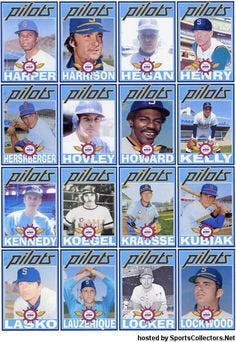
Consider the names: regular shortstop Ray Oyler hit .165; Merritt Ranew played 54 games without a home run or a stolen base; and neither Tommy Davis nor Billy Williams added anything more than marquee names from earlier times.
The ballpark, appropriately called Sick’s Stadium, was far from healthy. It was rundown, delapidated, and unfit even for an expansion franchise.
Formerly the home of the Triple-A Seattle Rainers, the ballpark had to be converted to major-league standards. It didn’t meet that deadline, with only 18,000 seats available on Opening Day. Coupled with the club’s poor play and the notoriously wet climate of Seattle, the Pilots persuaded only 677,944 to pay their way through the turnstiles. Average attendance was 8,268.
In just their 17th game, the novelty had worn off; only 1,954 attended.
By June, rumors of relocation swirled. Owner Dewey Soriano agreed to sell to someone named Allan H. (Bud) Selig, a Milwaukee car salesman who owned stock in the Braves before that team split for Atlanta in 1966.
Much litigation ensued but the transaction eventually went through one week before Opening Day of the 1970 season. Sale price was $10.8 million — about twice as much as the average salary today.
The timing of the move complicated life for Topps, which includes players of the new Milwaukee Brewers on Seattle Pilots cards, and for the team’s traveling secretary, who suddenly had to organize the longest road trips in the majors (the Brewers-nee-Pilots stayed in the AL West for two seasons before switching to the AL East in 1972).
Nor was the equipment manager pleased: trucks bearing the team’s gear sat in Provo, UT while drivers awaited word whether to proceed to Seattle or Milwaukee.
At least new manager Dave Bristol became the answer to a trivia question: who managed the Seattle Pilots without ever managing a game in the regular season?
When the league created the Seattle Mariners in 1977, journeyman pitcher Diego Segui got the chance to pitch opening games for two Seattle expansion teams.
The Pilots actually won their first game and their first road game but otherwise made it easy for Bouton to write an exposé called Ball Four from his berth in the bullpen (before he was shipped to Houston in August). It won him no friends in baseball clubhouses but landed him gigs as a wise-cracking TV sportscaster.
He never developed a taste for liverwurst.
HtP weekend editor Dan Schlossberg of Fair Lawn, NJ is the author of 43 baseball books and an adjunct professor, teaching baseball oddities and ironies, at the Institute for Learning in Retirement at Bergen Community College. He covers baseball for forbes.com and many other outlets. Dan’s e.mail is ballauthor@gmail.com.
Extra Innings: New Names to Know
“You understand these stats are going to happen sometime.”
— Mets shortstop Francisco Lindor explaining why he has zero RBIs so far
The year’s biggest surprise so far is Dodgers outfielder Andy Pages, whose previous claim to fame was making the catch the saved the 2025 World Series . . .
Both the Twins (starter Taj Bradley) and Rays (reliever Griffin Jax) are thrilled after exchanging two pitchers who routinely reach triple digits . . .
With the Yankees suffering from an uncertain bullpen, watch for flame-throwing Carlos Lagrange as a solution — even though the team prefers him as a starter . . .
Yankees castoff TJ Rumfield is thriving in the alpine air of Denver . . .
And Joey Wiemer, in his fifth different organization, is making the most of his unorthodox swing in Washington . . .
The on-field fight between Jorge Soler (Angels) and Reynaldo Lopez (Braves) probably precludes any chance of the 2021 World Series MVP returning to Atlanta . . .
After Marcell Ozuna left, the Braves turned DH duties over to ex-Met Dom Smith, who suddenly seems like a threat at the plate.
Know Your Editors
Here’s the Pitch is published daily except Sundays and holidays. Benjamin Chase [biggentleben@hotmail.com] handles the Monday issue with Dan Freedman [dfreedman@lionsgate.com] editing Tuesday and Jeff Kallman [easyace1955@outlook.com] at the helm Wednesday and Thursday. Original editor Dan Schlossberg [ballauthor@gmail.com], does the weekend editions on Friday and Saturday. Former editor Elizabeth Muratore [nymfan97@gmail.com] is now co-director [with Benjamin Chase and Jonathan Becker] of the Internet Baseball Writers Association of America, which publishes this newsletter and the annual ACTA book of the same name. Readers are encouraged to contribute comments, articles, and letters to the editor. HtP reserves the right to edit for brevity, clarity, and good taste.